
By: John S. Morlu II, CPA
Most business owners think they have a people problem.
I thought I had a visibility problem.
As it turns out, I had both.
Several years ago, our company had grown to more than 60 employees spread across multiple teams, projects, countries, and service lines.
On paper, everything looked healthy.
People showed up to work.
Meetings were happening.
Emails were flying.
Projects were active.
Everyone appeared busy.
Very busy.
Yet somehow deadlines were still being missed.
Projects stalled.
Issues surfaced too late.
Managers were frustrated.
Employees were frustrated.
And as CEO, I had a nagging feeling that despite all the activity, I could not clearly see what was actually happening inside my own company.
The Software Buying Spree
Like many business owners, I assumed software would solve the problem.
So I bought software.
Then more software.
Then even more software.
First came Twilio.
Then Slack.
Then Jira.
Then Asana.
Then Monday.com.
Then Clockify.
Then RingCentral.
Then Microsoft 365.
Then VPNs.
Then integrations.
Then consultants to help manage the integrations.
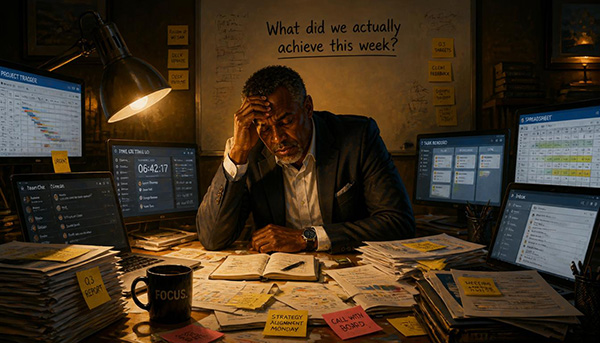
Soon we were spending nearly $6,000 every month on software subscriptions.
And yet I still could not answer a simple question:
What results did our company actually achieve this week?
Ironically, we had become experts at tracking everything except performance.
We could track:
- Tasks
- Tickets
- Hours
- Messages
- Meetings
- Logins
- Activity
But we struggled to track:
- Results
- Achievements
- Risks
- Opportunities
- Blockers
- Decisions needed
We had visibility into work.
We lacked visibility into outcomes.
Drowning in Systems
The software wasn’t broken.
The software was doing exactly what it was designed to do.
Jira tracked tickets.
Asana tracked projects.
Clockify tracked time.
Slack tracked conversations.
RingCentral tracked communications.
The problem was that every system generated more information.
And more information required more management.
Soon we found ourselves spending more time managing software than improving performance.
We had accidentally created an entire ecosystem dedicated to activity management.
And the more systems we added, the harder it became to understand reality.
We were drowning in data while starving for insight.
The Conversation That Changed Everything
In November, we hired a young Chief of Staff.
Bright.
Curious.
Obsessed with learning.
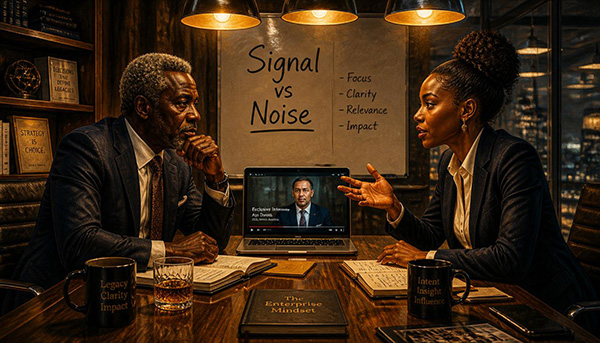
One day we were on a video call when an interview appeared featuring one of the Shark Tank investors discussing Steve Jobs.
The conversation centered on signal and noise.
The point was simple.
Great leaders focus on signal.
Most organizations focus on noise.
The speaker mentioned that Steve Jobs had an extraordinary ability to filter signal from noise, while most people become overwhelmed by information.
My Chief of Staff paused and said:
“John, I have read about that concept before.”
Then she asked a question that would eventually change our company.
“Why don’t we build a signal reporting system?”
Not another task management system.
Not another ticketing system.
Not another time tracking platform.
A signal reporting system.
A system focused entirely on performance visibility.
I immediately said:
“Do it.”
The Pen and Paper Experiment
Before writing a single line of software, we tested the concept with pen and paper.
Employees reported:
What they planned to accomplish.
What they actually accomplished.
What was blocked.
What risks existed.
What opportunities had emerged.
What decisions were needed.
That was it.
Simple.
No complicated workflows.
No ticket numbers.
No project bureaucracy.
No endless updates.
No endless meetings.
Just signal.
Initially, four employees resisted.
Strongly.
They preferred the old way.
The familiar way.
I eventually intervened and made it clear that this new reporting process was not optional.
Today, those same employees have become some of the strongest advocates for the system.
Because once they experienced it, they understood something important:
The system wasn’t designed to monitor them.
It was designed to make their contributions visible.
Something Unexpected Happened
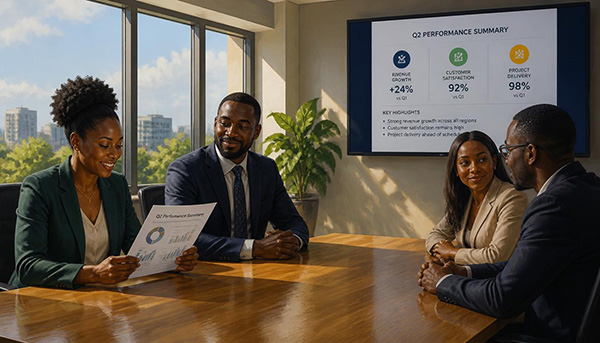
Within weeks, the quality of management discussions changed.
Meetings became shorter.
Managers became more informed.
Issues surfaced earlier.
Accountability improved.
Decision-making improved.
Employees started focusing less on activity and more on outcomes.
Something else happened.
Employees began feeling better about their work.
Why?
Because people like accomplishment.
People like progress.
People like seeing evidence that their effort matters.
When employees can clearly identify what they achieved this week, something powerful happens psychologically.
Work becomes meaningful.
Progress becomes visible.
Motivation increases.
People stop measuring success by how busy they were.
They start measuring success by what they accomplished.
Turning the Concept Into Software
After three months of using the paper-based process, the results were undeniable.
Our Chief of Staff approached our engineering team.
She assigned the project to one of our young software engineers.
In remarkably short order, Signal Playbook AI was born.
Not as another project management system.
Not as another HR platform.
Not as another time tracking tool.
But as something different.
A Performance Visibility Platform.
A platform designed to help organizations see what is actually happening.
The Signal Framework
Every accomplishment is connected to organizational impact.
In our case, employees identify how their work contributed to:
☑ Revenue
☑ Operations
☑ Administration
☑ Technology Infrastructure
☑ Product & Software Development
☑ Technical Services
They also classify each signal as:
☑ Achievement
☑ Risk
☑ Blocker
☑ Opportunity
☑ Decision Needed
Those two simple dimensions transformed reporting.
Suddenly leadership could identify:
- Emerging risks
- Hidden opportunities
- Organizational bottlenecks
- Resource constraints
- Areas of high performance
without requiring dozens of meetings.
The Lesson
Most organizations do not suffer from a lack of software.
Most suffer from a lack of visibility.
They have systems for managing tasks.
Systems for managing time.
Systems for managing projects.
Systems for managing communication.
What they often lack is a system for understanding performance.
That is why we built Signal Playbook AI.
Not to create more reporting.
Not to create more software.
Not to create more work.
But to help leaders answer one of the most important questions in business:
What results did we achieve this week?
Because when performance becomes visible:
Employees feel recognized.
Managers make better decisions.
Leaders identify problems earlier.
Organizations execute better.
And everyone spends less time managing noise.
Signal Playbook AI
Weekly Performance. Without the Noise.
Author: John S. Morlu II, CPA is the CEO and Chief Strategist of JS Morlu, a licensed public accounting and management consultancy firm. He has more than 20 years of professional experience in auditing and advisory work, including service as Auditor General of Liberia and FAR and DCAA compliance work at Unisys Federal Systems. The firm’s technology products include AI-powered reconciliation software (ReckSoft.com), a handyman services platform (fixaars.com) and advanced cloud accounting solutions (FinovatePro.com), built for finance and operations teams. Co-Founder, Signalplaybookai.com