
By: John S. Morlu II, CPA
Most small business owners did not start their businesses to manage HR systems.
They started their businesses to:
- Grow revenue
- Serve customers
- Build great teams
- Create jobs
- Deliver results
Yet somewhere along the way, many organizations became obsessed with tracking activities instead of outcomes.
They know:
✓ Who clocked in
✓ Who completed training
✓ Who submitted forms
✓ Who attended meetings
✓ Who updated their profile
But often struggle to answer:
- What results were achieved this week?
- What moved the business forward?
- What is stuck?
- What is behind schedule?
- What requires leadership attention?
- Which employees are creating the most impact?
The reality is that most small businesses do not suffer from an HR problem.
They suffer from a performance visibility problem.
Employees are working.
Managers are managing.
Customers are being served.
But leadership cannot clearly see results, progress, risks, bottlenecks, or accountability.
And that gap is costly.
What the Visibility Problem Actually Looks Like
It usually starts small.
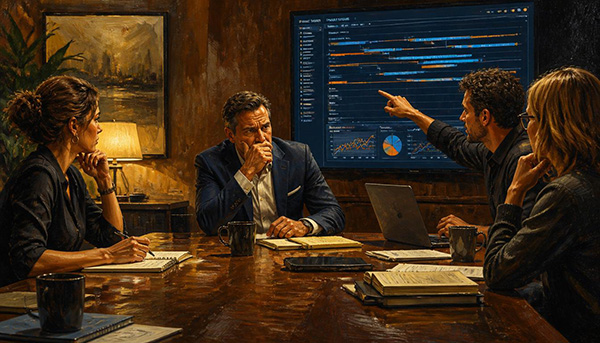
A project slips because no one flagged the delay early enough. A client issue escalates because the team assumed leadership already knew. A strong employee quietly disengages because their contributions were never acknowledged.
None of these failures happened because people stopped working.
They happened because leadership could not see what was actually going on.
As organizations grow from 10 employees to 50 employees to 100 employees, visibility declines and assumptions increase.
The response is usually predictable.
More meetings.
More reports.
More software.
More status updates.
Yet somehow leaders feel less informed than ever.
Why Activity Metrics Are Not Enough
Because activity is not the same thing as performance.
A task completed does not necessarily mean value was created.
A meeting attended does not necessarily mean progress occurred.
An email sent does not necessarily mean a problem was solved.
Most HR and workforce management systems are designed to track what people do. Clock-ins. Training completions. Form submissions. Attendance records.
These systems answer the wrong question.
Small business owners do not need another system that tells them what people did.
They need a system that helps them understand what people achieved.
There is a significant difference between the two.
The Shift Toward Performance Visibility
The future of small business management is not Human Capital Management.
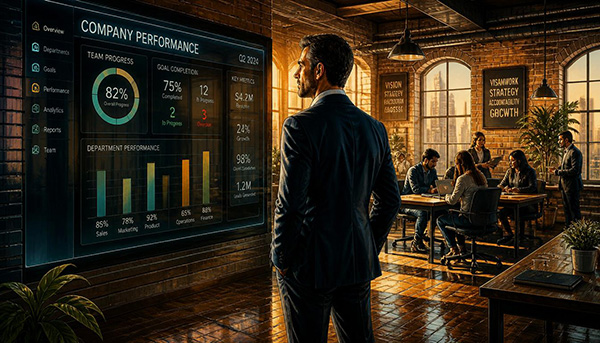
It is Performance Visibility.
The ability to see:
- Results delivered
- Problems solved
- Risks emerging
- Goals achieved
- Teams progressing
- Employees creating value
When leaders can see performance clearly, everything changes.
They recognize employees fairly, based on contribution rather than proximity to management.
They coach managers effectively, because they understand where support is actually needed.
They solve problems earlier, before small issues become expensive crises.
They make better decisions, because those decisions are grounded in reality rather than assumptions.
And they spend less time chasing information, which means more time leading.
The Question Every Leader Should Be Asking
The question is no longer:
“Did employees do the work?”
The question is:
“Did the work produce results?”
That shift in thinking changes how leaders manage, how managers lead, and how employees are recognized.
It also changes what tools organizations actually need.
Most small businesses are not under-managed. They are under-informed.
Giving leaders clearer visibility into performance does not create more bureaucracy. It reduces it. Fewer status meetings.
Fewer follow-up emails. Fewer assumptions.
That is the visibility gap facing millions of small businesses today.
And closing it may be the single biggest opportunity for improving performance over the next decade.
Signal Playbook AI
Weekly Performance. Without the Noise.
Author: John S. Morlu II, CPA is the CEO and Chief Strategist of JS Morlu, a licensed public accounting and management consultancy firm. He has more than 20 years of professional experience in auditing and advisory work, including service as Auditor General of Liberia and FAR and DCAA compliance work at Unisys Federal Systems. The firm’s technology products include AI-powered reconciliation software (ReckSoft.com), a handyman services platform (fixaars.com) and advanced cloud accounting solutions (FinovatePro.com), built for finance and operations teams. Co-Founder, Signalplaybookai.com