
By: John S. Morlu II, CPA
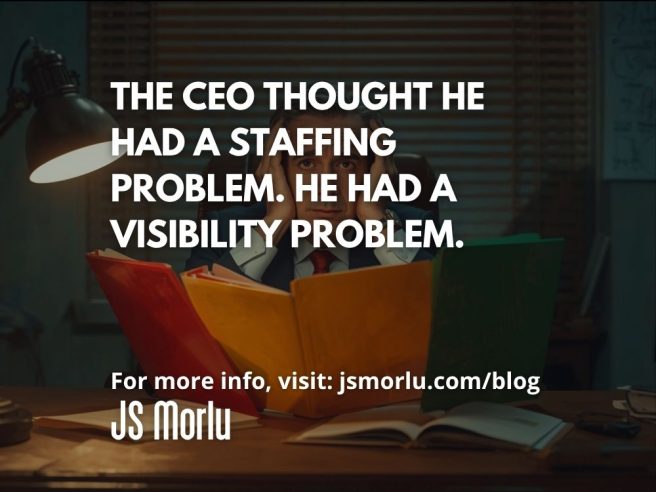
The CEO was frustrated.
Projects were taking longer.
Managers seemed overwhelmed.
Employees looked busy.
Meetings filled the calendar.
Yet results were not improving. He had run every number twice, certain the answer would eventually explain itself.
His first conclusion?
“We need better people.”
His second conclusion?
“We need more managers.”
His third conclusion?
“We need another software system.”
Three conclusions. Three budget lines. None of them addressed the actual problem.
He was wrong on all three. Not because the ideas were bad. Because they were solutions to a problem he had misdiagnosed.
The real problem was simpler.
Nobody could clearly see what was happening.
Not the CEO.
Not the managers.
Not the employees.
Everyone was operating with partial information. Each person had a piece of the picture. Nobody had all of it, and nobody realized how much that mattered until it was pointed out.
Managers spent their days chasing updates.
Employees spent their days responding to requests.
Leadership spent their days trying to understand reality. Three groups, three different jobs, and all three secretly doing the same thing: guessing.

Picture the CEO reviewing three separate weekly reports, each telling a slightly different version of the same project.
None of the three managers were lying. They just each had their own partial view, and nobody had reconciled them. Every manager in that meeting had already noticed pieces of what was wrong. Nobody had a way to put those pieces next to each other.
The organization wasn’t suffering from a talent shortage.
It was suffering from a visibility shortage. That distinction changes everything about where you spend money to fix it. A talent shortage gets solved by hiring. A visibility shortage gets solved by seeing. Confusing the two wastes both time and money.
And visibility shortages are expensive.
They create:
- More meetings
- More emails
- More frustration
- More assumptions
- More surprises
None of these five costs show up as a line item. They just quietly consume the hours that should have gone toward actual work.
But fewer results.
The highest-performing organizations do not necessarily have better people.
They have better visibility. That single difference explains more about performance gaps than talent, budget, or effort combined.
They know:
- What got done
- What is blocked
- What is behind schedule
- What requires attention
- What leadership needs to know
Five things. Most organizations can answer maybe two of them without a meeting first.
Before it becomes a crisis.

Consider what changed once the CEO could finally see results directly.
The same managers, the same employees, the same budget, just visibility that didn’t depend on someone remembering to mention a problem. The fix was not complicated once he understood the actual diagnosis. It just required someone finally naming the real problem instead of the symptoms.
The future of small business will not be won by companies with the most software.
It will be won by companies that can see reality the fastest. Speed here has nothing to do with hustle. It has to do with how quickly the truth reaches the person who can act on it.
Because you cannot fix what you cannot see.
And you cannot lead what you do not understand.
That’s why the next competitive advantage isn’t another dashboard.
It’s visibility. The CEO didn’t need to fire anyone or hire anyone. He just needed to actually see what his own organization was already telling him.
Signal Playbook AI
Weekly Performance. Without the Noise.
Author: John S. Morlu II, CPA is the CEO and Chief Strategist of JS Morlu LLC, a licensed public accounting and management consultancy firm in Woodbridge, Virginia. He has more than 20 years of professional experience in auditing and advisory work, including service as Auditor General of Liberia and FAR and DCAA compliance work at Unisys Federal Systems. He has led international audit engagements and works across the firm’s government contracting, assurance and advisory practices. He is also the founder of ReckSoft, FinovatePro, Fixaars, Signal Playbook AI and Ratevora.