
By: John S. Morlu II, CPA
It is what leadership does not know.
Most executives believe their biggest threats are:
- Bad strategy
- Poor execution
- Market disruption
- Cash flow problems
Those threats are real.
But they are visible.
And visible problems get managed.

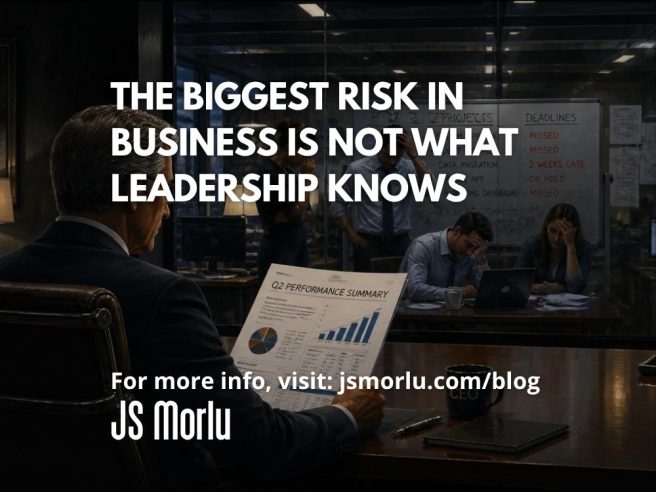
The real danger is the problem nobody reported.
The customer who almost churned.
The team member who is about to quit.
The process that has been failing quietly for months.
The project that is behind schedule but nobody said anything.
In most organizations, information flows upward selectively.
Good news travels fast.
Bad news travels slowly.
Problems often reach leadership only after they have already become crises.
By then, the cost of fixing them is ten times higher than it would have been earlier.
Why Visibility Disappears First
Visibility does not vanish all at once.
It erodes one skipped update at a time.
A manager softens a status report to avoid a hard conversation.
A team member stays quiet because raising a concern feels risky.
A missed deadline gets quietly pushed instead of flagged.
None of these moments feel dangerous on their own.
But they compound.
And by the time leadership notices, the small problem has become the org-wide one.
The Cost of Finding Out Late
A customer who churns without warning costs more than one who raises concerns early.
An employee who quits without notice costs more than one who is coached through frustration.
A project discovered behind schedule in week ten costs more to recover than one flagged in week two.
Every one of these problems was knowable.
Someone, somewhere, already saw it coming.
The failure was never a lack of information.
It was a lack of a system built to surface it.

Visibility is not a nice-to-have.
It is a risk management strategy.
Building Visibility Into the System
Waiting for people to speak up is not a strategy.
It relies on courage, timing, and trust — none of which are consistent.
Instead, visibility has to be built into how a team operates.
That means structured, recurring reporting that does not depend on someone deciding a problem is “bad enough” to mention.
It means a leadership cadence where quiet risks are expected to surface, not stumbled upon.
It means leaders who ask “what’s not working” as often as they ask “what’s on track.”
The organizations that consistently outperform are not the ones with the best strategies.
They are the ones where leadership actually knows what is happening.
Signal Playbook AI
Weekly Performance. Without the Noise.
Author: John S. Morlu II, CPA, is the CEO and Chief Strategist of JS Morlu, who leads a licensed public accounting and management consultancy firm. He has more than 20 years of professional experience in auditing and advisory work, including service as Auditor General of Liberia and FAR and DCAA compliance work at Unisys Federal Systems. The firm’s technology products include AI-powered reconciliation software (ReckSoft.com), a handyman services platform (Fixaars.com) and advanced cloud accounting solutions (FinovatePro.com), built for finance and operations teams. Signal Playbook AI and Ratevora are the newest additions.