
Life Between Wind, Water, and Tradition
By: John S. Morlu II, CPA
When you enter the rural parts of the Volta Region, something shifts — not in the land, but in you. The villages of Volta do not announce themselves. They whisper. They breathe. They wait for you to adjust your senses, slow your steps, and listen with the kind of attention modern life has stolen from us.
Volta villages are built between wind, water, and tradition — three elements that shape the daily rhythm of the people more than clocks ever will. Here, mornings begin softly, afternoons move with purpose, and evenings settle into stories and silence. The beauty is not loud. The charm is not artificial. The culture is not performed for tourists.
Volta villages are authentic without trying — grounded without effort, peaceful without pretending, and full of meaning without saying much. This chapter takes you inside these villages, where life is simple but not simplistic, traditional but not stagnant, communal but not intrusive. The Volta Region holds some of Ghana’s most dignified rural communities, and each one carries its own story.
1. The Geography — Villages Carved Into Nature’s Calm
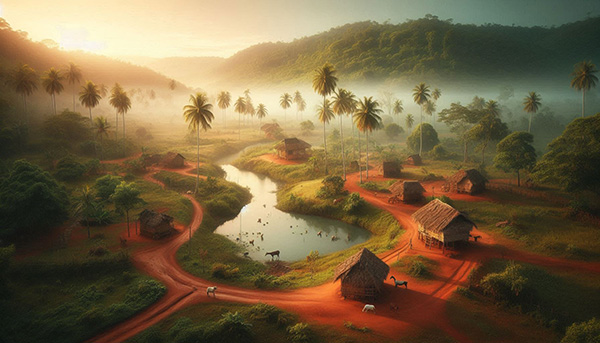
Volta villages live in harmony with nature in a way that feels almost choreographed. They do not fight the land; they follow its rhythm.
Some villages are:
- Perched on hillsides overlooking valleys
- Hidden within lush forests
- Stretched along riverbanks
- Nested beside lagoons
- Scattered across plains where goats think they own the land
- Set near beaches that the ocean constantly tries to reclaim
You find:
- Quiet morning mist
- Endless greenery
- Red-earth pathways shaped by bare feet and rainfall
- Compounds surrounded by coconut, mango, or baobab trees
The land speaks softly, but consistently. And the villages listen.
2. Village Life — Calm, Structured, and Purposeful
Life in Volta villages is simple — but not in the way outsiders imagine. It is intentional simplicity, not forced simplicity.
Here, people live in a slow-burning harmony:
- Women wake early to fetch water, sweep compounds, and prepare breakfast.
- Men head to farms, fishing grounds, or workshops.
- Children run barefoot with joy and mischief in equal measure.
- Elders sit in shaded corners, watching the day unfold with quiet wisdom.
The pace of life is not dictated by stress, but by:
- The rising sun
- The readiness of crops
- The arrival of fishing boats
- The blowing of wind
- The calling of birds
- The sound of distant drums
In Volta villages, time is measured not in minutes, but in meaning.
3. The Architecture — Order, Ancestry, and Practical Design
Traditional Ewe villages carry a beauty that is not Instagram-driven. It is subtle and functional, shaped by climate, tradition, safety, spirituality, and communal life.
- Arranged in family compounds
- Built with respect for lineage
- Designed to maximise airflow
- Crafted using nature itself — clay, bamboo, wood, palm fronds
Kitchens sit outside because food and fire need fresh air. Bathrooms sit discreetly behind structures. Verandas act as living rooms. Tree shade becomes social space. A compound is not just a home — it is a map of family history.
One courtyard may hold:
- Grandmother’s room
- The eldest son’s room
- An empty room for visitors
- A shrine house
- A storage hut
- A kitchen
- Two goats that refuse to cooperate
- A mango tree everyone claims but no one planted
Every structure has a purpose, and every purpose has a story.
4. The People — Reserved, Wise, Warm, and Quietly Proud
Volta villagers share a personality shaped by centuries of discipline and culture.
- Reserved but not cold
- Wise but not boastful
- Hardworking but not noisy
- Spiritual but not superstitious
- Calm but not passive
- Deeply proud but not arrogant
They do not rush to speak. They do not talk over each other. They do not exaggerate stories. They do not perform hospitality — they embody it.
Guests often find themselves receiving:
- Water
- Fresh palm wine
- Fruits
- Food
- A seat under the biggest tree
The generosity is not because you are special — it is because their culture commands it.
5. The Economy — Farming, Fishing, and Everyday Artistry
Volta village economies are not cash-heavy. They are dignity-heavy.
Farming
Villagers plant:
- Cassava
- Maize
- Yam
- Plantain
- Cocoyam
- Vegetables
- Pepper
- Okro
- Garden eggs
- Cocoa in some highland areas
Farming is not just economic — it is identity.
Fishing
In coastal and riverine villages:
- Nets stretch across beaches like art
- Fishing boats return at dawn like tired warriors
- Smoked fish markets come alive with negotiation
The relationship between villagers and water is spiritual.
Craftsmanship
Ewe villages are hubs of:
- Weaving
- Pottery
- Basketry
- Wood carving
- Beadwork
- Blacksmithing
- Salt-making (especially near Keta and Anloga)
These crafts are passed down quietly, like secrets.
6. Social Life — Community First, Individual Second
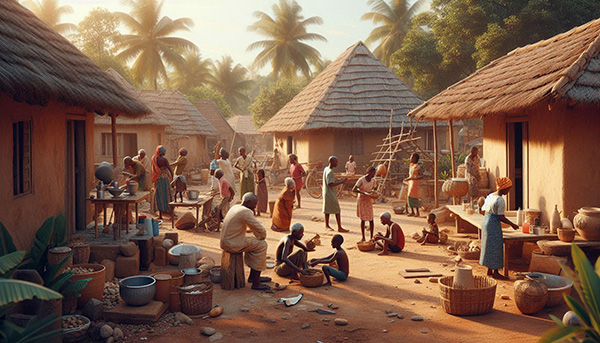
Volta villages operate by a social principle that modern cities envy: the community watches over each other.
If a child misbehaves, any adult can correct them. If someone is sick, neighbours come before nurses. If a family has no food, others share without being asked. If a guest visits, the whole household mobilises to host properly.
Social responsibilities include:
- Helping with construction
- Attending funerals
- Participating in community cleaning
- Assisting the elderly
- Volunteering during festivals
- Contributing to communal events
A village is one big extended family — sometimes annoying, sometimes overwhelming, but always reassuring.
7. Festivals — When Villages Become Kingdoms
In many villages, festivals are the climax of the year. Events such as:
- Hogbetsotso
- Dzawuwu
- Deza
- Kente Festival (Agbamevorza)
- Anlo Ewe purification ceremonies
Turn quiet villages into centres of:
- Dance
- Drumming
- Storytelling
- Spiritual cleansing
- Reunions
- Ancestral honour
Festivals remind villagers that they belong to something bigger than themselves — a history, a kingdom, a people.
8. The Relationship With Nature — Respect, Fear, and Friendship
Villagers in the Volta Region do not see nature as an object. They see it as:
- Teacher
- Friend
- Warning system
- Spiritual presence
Mountains are alive. Trees have spirits. Rivers have moods. The ocean has a personality. Animals carry messages. Dreams are maps. You cannot live in a Volta village and be disconnected from nature — it is impossible. Nature sets the terms, and the villagers negotiate respectfully.
9. Challenges — Quiet Battles Fought Daily
Despite their beauty, Volta villages face challenges:
- Erosion along coastal and lagoon communities
- Youth migration
- Limited job opportunities
- Unpredictable rainfall patterns
- Lack of modern infrastructure
- Pressure from modernisation
- Occasional political neglect
But the resilience is unmatched. These villages have survived:
- Wars
- Colonisation
- Environmental changes
- Displacement
- Economic shifts
They will survive this era too.
10. Conclusion — Volta Villages Are Not Backward; They Are Beautiful
To call these villages “rural” is to reduce them. To call them “undeveloped” is to misunderstand them. To call them “simple” is to miss their intelligence.
Volta villages are:
- Spiritual communities
- Cultural libraries
- Architectural lessons
- Ecological examples
- Philosophical spaces
- Human stories wrapped in humility
- Places where noise does not rule
- Relationships matter
- Nature is respected
- Elders are libraries
- Spirituality is woven into daily life
- Time moves with the wisdom of slowness
Volta villages are not behind — they are grounded. And in a world obsessed with speed, a grounded life is not backward — it is superior.
Author: John S. Morlu II, CPA is the CEO and Chief Strategist of JS Morlu, leads a globally recognized public accounting and management consultancy firm. Under his visionary leadership, JS Morlu has become a pioneer in developing cutting-edge technologies across B2B, B2C, P2P, and B2G verticals. The firm’s groundbreaking innovations include AI-powered reconciliation software (ReckSoft.com), Uber for handymen (Fixaars.com) and advanced cloud accounting solutions (FinovatePro.com), setting new industry standards for efficiency, accuracy, and technological excellence.