
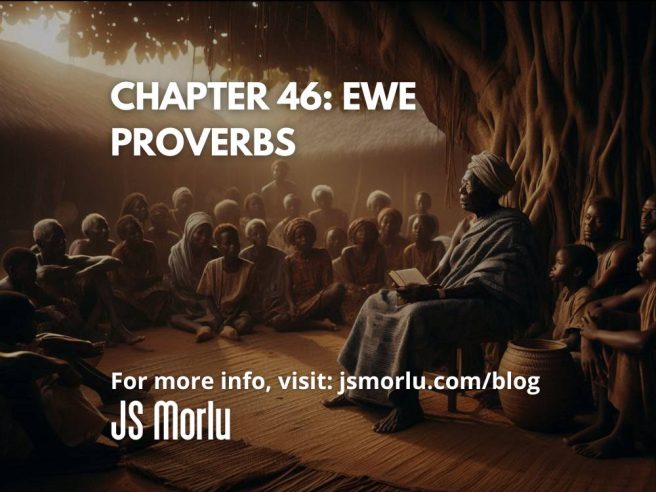
Wisdom Sharper Than Knives, Softer Than Rain
By: John S. Morlu II, CPA
If you want to understand the Ewe people, do not ask questions. Listen to their proverbs.
Ewe proverbs are weapons and blankets at the same time — sharp enough to correct a mistake, gentle enough to comfort a wounded heart, deep enough to challenge a scholar, and simple enough for a child to memorise.
In Ewe culture, elders rarely speak directly. They do not waste words. They do not argue unnecessarily. They do not embarrass you by correcting you openly. Instead, they drop a proverb — a small sentence so precise that the entire room falls silent.
Because Ewe proverbs do not explain. They reveal. And when an elder releases one, you feel it.
This chapter explores the wisdom that has carried the Ewe people for centuries — wisdom hidden in poetry, humour, philosophy, metaphor, and truth sharpened by time.
1. Proverbs as Identity — The Ewe Way of Thinking in Layers
To the Ewe, a proverb is not an accessory. It is a form of intelligence.
Ewe people speak with precision, measured tone, metaphor, and layered meaning. A single proverb can settle arguments, teach ethics, guide life decisions, correct foolishness, preserve history, and transmit ancestral knowledge.
- Precision
- Measured tone
- Metaphor
- Layered meaning
- Settle arguments
- Teach ethics
- Guide life decisions
- Correct foolishness
- Preserve history
- Transmit ancestral knowledge
When an elder says, “Nunya, adidoe.” (Knowledge is like a baobab tree — no one embraces it alone.), they are not merely encouraging learning. They are teaching humility, cooperation, wisdom, and the limits of individual power.
Every proverb is a lesson, a warning, and a mirror.
2. Proverbs About Wisdom — The Foundation of Ewe Life
“Nunya, adidoe.”
Wisdom is like a baobab tree; no one person can embrace it alone.
Meaning: Wisdom is communal, endless, and grows through cooperation.
“Xexeame le vɛvɛ me.”
Patience lives inside wisdom.
Meaning: Wisdom without patience is incomplete.
“Ne wòada gbe, na wòate ŋu.”
If you wake up (to life), may you understand.
Meaning: Living is not enough; understanding is the real achievement.
“Agbe dzi o.”
Life has no duplicate.
Meaning: Protect your life — nothing can replace it.
These proverbs shape character more effectively than any textbook.
3. Proverbs About Character — Quiet Warnings Wrapped in Poetry
“Wòkplɔa dzimɛ dua, màtsɔa.”
If you show me the stump of your heart, I will show you mine.
Meaning: People reciprocate the energy you give.
“Ne eɖe wò tso ge gbe o, mèɖe nɔvi o.”
If someone does not truly know you, they cannot be your sibling.
Meaning: Relationship runs deeper than blood; understanding defines family.
“Se kae me nya wò, dɔme wò.”
Your character is your inner clothing.
Meaning: Who you are inside matters more than outward appearance.
“Ne dzra ɖe wòƒe asi me la, wòatsɔa.”
If something enters your hand, your character will reveal itself.
Meaning: Power exposes true nature.
These are not insults. They are gentle but sharp corrections.
4. Proverbs About Silence — The Ewe Preference for Quiet Intelligence
Ewe culture values silence. Silence is not fear; it is strategy. It is power.
“Mietsɔ gbe sí míewo.”
We don’t pull voices; we pull hearts.
Meaning: Influence comes from integrity, not noise.
“Gbe maɖi o; ne mɖe kua nu la, wònya.”
A word does not rot; if it grows mould, you will see.
Meaning: Truth reveals itself with time.
“Tɔgbui gɔme be yɔ kple vovo.”
An elder’s silence is full of words.
Meaning: Silence itself can be instruction.

5. Proverbs About Community — No One Survives Alone
“Abɔbɔ le te, ke wò be woaɖu la.”
The snail is slow, but it reaches its destination.
Meaning: Progress differs for everyone; support matters.
“Ame mewɔ nu o; ame kple ame na wɔ nu.”
A person cannot accomplish anything alone; people support people.
Meaning: Community is strength.
“Aƒe yi wò.”
May your home be strengthened.
A blessing disguised as a proverb.
In Ewe culture, the home is not merely a building — it is the foundation of identity.
6. Proverbs About Leadership — Calm, Disciplined, and Wise Rule
“Agbalẽ kple kɔme tɔ to wo.”
The drum and the skin must agree to make good music.
Meaning: Leadership requires cooperation.
“Ne ame nyo la tɔ na wo.”
If a person is good, they will lead the way.
Meaning: Character earns leadership, not title.
“Tɔgbui mekɔ nu kple nu.”
An elder does not mix matters recklessly.
Meaning: A good leader acts with restraint and care.
These proverbs explain why Ewe leadership tends to be calm, structured, and deliberate.
7. Proverbs About Money — Financial Wisdom Without Banks
Ewe economic thinking is practical and often delivered through humour.
“Sika tsɔa ame ta me da akpa.”
Money can wash a person’s head without water.
Meaning: Money changes circumstances.
“Se si meɖe wò o, mèɖe woƒe agbo o.”
If you cannot manage your character, you cannot manage your wealth.
Meaning: Discipline protects prosperity.
“Ame me ɖa ame sika yome o.”
A person does not reveal the source of their wealth to everyone.
Meaning: Discretion protects fortune.
This wisdom explains why many Ewe people build quietly, without unnecessary display.
8. Proverbs About Human Nature — Truth Without Flattery
“Ne ame bla nú le wòƒe agbe me la, ekema wòana.”
If someone is destroying their life, they will refuse advice.
Meaning: Some people only learn through consequences.
“Ame siwo de akpa me nye wo, menye woawɔa o.”
Those who smile at you are not always your friends.
Meaning: Discernment is essential.
“Ne wotsɔ kɔkpɔe la, ne eɖe wò le eme la, wòna.”
When someone shows you who they truly are, believe them.
Meaning: Patterns do not lie.
This is the psychological sharpness of Ewe proverbs — concise, accurate, and uncomfortably honest.
9. Proverbs About Love — Gentle, Truthful, and Realistic
Love in Ewe wisdom is not fantasy. It is disciplined, realistic, and mature.
“Fiɛ me tɔ afi o.”
Love does not stand on one leg.
Meaning: Love requires effort from both sides.
“Ne ame dzɔ gbe me la, wòtsɔa asime nu ko.”
If someone is dear to you, you speak softly to them.
Meaning: Love expresses itself kindly.
“Ame si le wò dzi la, wòagblɔ na wo.”
The person in your heart deserves honesty.
Meaning: Truth anchors love.
This gentle realism has preserved relationships for generations.
10. Conclusion — Proverbs as the DNA of Ewe Civilisation
Ewe proverbs are not casual sayings. They are cultural software — the operating system of an intelligent civilisation.
Within them live:
- Ethics
- Leadership
- Morality
- Honesty
- Psychology
- Financial intelligence
- Community values
- Spiritual understanding
- Emotional maturity
- Resilience
Ewe proverbs remind us that true wisdom does not shout. It whispers — not loudly, but deeply.
And those who listen become wiser, calmer, stronger, and more human.
These proverbs are the soul of the Ewe people — sharp enough to correct, soft enough to heal, deep enough to guide, and timeless enough to outlive us all.
Author: John S. Morlu II, CPA is the CEO and Chief Strategist of JS Morlu, leads a globally recognized public accounting and management consultancy firm. Under his visionary leadership, JS Morlu has become a pioneer in developing cutting-edge technologies across B2B, B2C, P2P, and B2G verticals. The firm’s groundbreaking innovations include AI-powered reconciliation software (ReckSoft.com), Uber for handymen (Fixaars.com) and advanced cloud accounting solutions (FinovatePro.com), setting new industry standards for efficiency, accuracy, and technological excellence.