
By: John S. Morlu II, CPA
In a world where headlines are dominated by noise, crisis, and political volatility, Benin has emerged as one of Africa’s least discussed but most quietly impressive nations. Tucked between Nigeria, Togo, and Burkina Faso, this small West African country of about 13 million people has built a legacy of peaceful democracy, stable macroeconomic management, and deliberate modernization.
It’s not flashy. It’s not loud. But it’s working. And in a region often defined by instability, that’s no small achievement.

A Stable Democracy in a Volatile Neighborhood
Benin’s political stability is no accident — it’s the result of deliberate design and decades of civic maturity. Since the adoption of its democratic constitution in 1991, following years of Marxist rule under Mathieu Kérékou, the country has consistently upheld a multi-party system, independent judiciary, and peaceful transitions of power.
That constitution, born from the famous 1990 National Conference of Active Forces of the Nation, was revolutionary. It gathered civil society, opposition figures, religious leaders, and even the military under one roof to forge a consensus for democracy.
At the time, few African nations had attempted such an open dialogue — and even fewer succeeded. But Benin did. The country’s early elections in the 1990s became a model for others across the continent, showing that African nations could move from authoritarianism to democracy through consensus rather than conflict.
Today, Benin’s democracy is not defined by slogans or drama but by routine functionality — ministries that operate, institutions that endure, and an electorate that largely trusts the system. While the rest of the subregion has faced coups, constitutional crises, and unrest, Benin has remained steady — a rare political island of calm in West Africa.
The African Development Bank, Freedom House, and World Bank consistently rank Benin among the region’s most stable and least polarized states. And perhaps the most telling sign of maturity: political change in Benin no longer shocks anyone — it’s expected, planned for, and peacefully managed.
Steady Economic Management
Economically, Benin has chosen substance over spectacle. Over the last decade, GDP growth has averaged 5–6% annually, even amid global disruptions from the pandemic, regional insecurity, and inflationary shocks. This growth has been driven by agriculture, infrastructure, logistics, and a rising service sector centered in Cotonou, the country’s commercial capital.
The International Monetary Fund’s 2025 review praised Benin’s government for maintaining macroeconomic stability and pursuing reforms that “anchor confidence in fiscal management.” Public debt remains sustainable at about 49% of GDP, comfortably below ECOWAS thresholds, and inflation hovers near the 3% target, even as neighboring economies have battled double-digit rates.
What’s remarkable is the discipline behind this progress. The Ministry of Economy and Finance, led by technocrats rather than political appointees, has modernized tax collection, digitized payments, and improved budget transparency. The result is a government that increasingly spends money as planned — and reports on it accurately.
Benin’s Programme d’Actions du Gouvernement (PAG), launched in 2016, is central to this discipline. Unlike typical political manifestos, PAG is a results-based framework with time-bound deliverables, regular audits, and measurable outcomes. Every two years, progress reports are published publicly — an uncommon level of transparency that has inspired confidence among international investors and development partners alike.
International credit rating agencies such as Moody’s and Fitch have cited Benin’s fiscal prudence as a key factor in its resilience, even during global downturns. The World Bank’s 2025 Doing Business indicators highlight Benin’s improvements in starting a business, access to credit, and cross-border trade.
In an African context, where financial management often collapses under politics, Benin’s quiet steadiness stands out as a model of competence and control.

Infrastructure and Electricity: Gradual but Real Progress
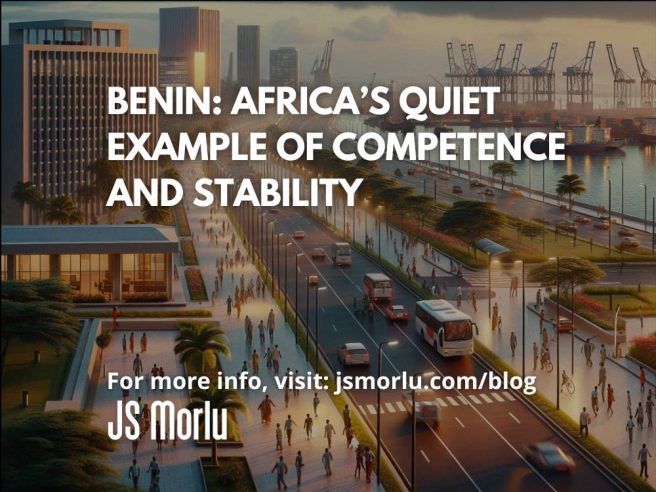
Infrastructure tells you more about a nation’s seriousness than speeches ever could. And in Benin, the transformation is visible — not theoretical.
The completion of the $375 million Millennium Challenge Corporation (MCC) Power Compact fundamentally changed the country’s energy landscape. This program modernized the national grid, rehabilitated substations, upgraded transmission lines, and introduced digital control systems that reduced technical losses and improved distribution efficiency.
By 2023, access to electricity had expanded to 57% of the national population, up from less than 30% a decade earlier. Urban access is now near-universal, with 9 out of 10 households in Cotonou enjoying stable electricity. Rural access remains lower but is improving through mini-grid projects, particularly in the north and northwest.
The government’s Power Compact II, supported by the MCC and the African Development Bank, is designed to push Benin toward universal access by 2035, focusing on renewable energy and cross-border interconnection with Nigeria and Togo.
But energy is only part of the story. Across Benin, asphalt roads are being built or rehabilitated — connecting agricultural regions to ports and markets. The Cotonou–Bohicon–Parakou highway, a critical economic corridor, has been fully resurfaced and expanded. New bridges over the Ouémé River now link historically isolated communities.
Meanwhile, the Port of Cotonou, Benin’s economic heartbeat, has been transformed through a management partnership with Port of Antwerp International. Once seen as inefficient, it now ranks among the top five ports in West Africa for operational efficiency. It serves as a major gateway for goods destined for landlocked Niger, Burkina Faso, and Mali — a vital regional logistics lifeline.
Clean streets, functioning streetlights, orderly traffic, and improved drainage now define Cotonou’s urban landscape — creating a sense of reliability rare in developing-world capitals.
Health and Education Reforms
Benin’s leadership understands that infrastructure without human development is an unfinished story. Under the PAG, health and education reforms have taken center stage.
The government has expanded regional hospitals, introduced a national health insurance program under the ARCH initiative, and invested in training health professionals to reduce dependence on foreign specialists. Diagnostic and treatment facilities that once required medical evacuation to Europe can now be accessed locally.
Maternal and infant mortality rates have declined, vaccination coverage has improved, and digital health records are being gradually rolled out. These improvements are reshaping the public perception of local healthcare — once viewed as unreliable, now increasingly trusted.
In education, the progress is equally encouraging. Benin’s literacy rate, once under 40%, has climbed steadily, driven by universal primary education and new teacher training programs. The free-education-for-girls policy has led to record female enrollment in both rural and urban areas.
The country has also introduced technical and vocational training institutions aligned with its industrial strategy — linking youth directly to job opportunities in construction, logistics, agriculture, and IT. According to the World Bank’s Human Capital Index (2024), Benin is among the top performers in Francophone West Africa for human capital development gains over the last five years.

Technology, Transparency, and Governance
Governance reform in Benin has gone digital — quite literally. The government’s e-Benin initiative has digitized over 100 administrative processes, from tax filing to business registration. Entrepreneurs can now incorporate companies, pay duties, and access customs services online without intermediaries — reducing both bureaucracy and corruption.
Public procurement is managed through electronic bidding systems. The budget process is transparent, published online, and subject to external review by international institutions. Citizens can track development projects in real time through the open-data portal, fostering civic accountability.
These reforms have yielded measurable results. Benin’s Transparency International score of 45 (2024) places it above the global average and among the best performers in West Africa. It is now viewed by the IMF and EU as a “credible reforming state” — a country that not only promises reform but executes it with consistency.
The difference between Benin and many of its peers lies not in rhetoric but in reliability — an administrative culture that treats governance as a craft, not a campaign.
The Cultural and Social Fabric
Beyond its institutions, Benin’s greatest strength may be its people — calm, honest, and remarkably united. Beninese society is defined by a rare blend of civility and quiet pride. Markets are vibrant but orderly, drivers obey traffic lights, and community life is guided by mutual respect.
Cotonou, in particular, radiates understated charm. Its seaside avenues, tidy intersections, and bustling artisan markets reveal a city that values order without losing soul. At dawn, joggers and cyclists fill the coastal roads; at dusk, the beaches of Fidjrossè come alive with music and laughter — not chaos, but community.
The country’s cultural identity is anchored in its rich history. The Dahomey Kingdom, once a powerful precolonial empire, has left an enduring legacy of organization and pride. Benin is also the spiritual birthplace of Vodun (Voodoo), celebrated every January 10th as a national holiday that draws tourists and diaspora visitors alike.
In Cotonou, the Wall of Graffiti — one of the longest continuous murals in Africa — stretches for nearly a kilometer, showcasing vibrant street art that celebrates freedom, unity, and innovation. Benin’s art scene, much like its governance, is subtle yet deeply authentic.

A Model of Practical Leadership
At the helm of this transformation stands President Patrice Talon, a pragmatic reformer and former businessman who governs with a CEO’s mindset. Talon’s administration is defined by performance contracts, measurable outcomes, and technocratic leadership. His ministers — many trained professionals with international experience — operate under a results-based management framework rarely seen in African governments.
Under his leadership, Benin has executed major public works on schedule, reduced fiscal waste, and implemented projects with transparency. The IMF, World Bank, and EU repeatedly cite Benin as an “implementation success story.”
Talon’s philosophy is simple: governance is a system, not a show. That system now underpins Benin’s image as a small country with big discipline — one that believes quiet competence will always outperform loud ambition.
The Future: Competence as a National Identity
Benin’s evolution is proof that nations can reform without revolution, progress without chaos, and modernize without losing humility. Its model is not built on natural resource wealth or populist ideology, but on discipline, execution, and systems thinking.
With continued investment in digital infrastructure, education, and fiscal transparency, Benin is positioning itself as a benchmark for governance in Africa — a nation that others can look to for practical inspiration.
Its story challenges the narrative that African progress must be noisy to be real. Sometimes, the loudest success is the one that whispers — through well-kept roads, working hospitals, balanced budgets, and a government that simply does its job.
For investors, policymakers, and observers searching for a different kind of African story — one defined not by slogans but by steady results — Benin offers a blueprint.
Because in the end, development doesn’t need spectacle; it needs systems. And in that quiet truth, Benin is leading by example.
Author: John S. Morlu II, CPA is the CEO and Chief Strategist of JS Morlu, leads a globally recognized public accounting and management consultancy firm. Under his visionary leadership, JS Morlu has become a pioneer in developing cutting-edge technologies across B2B, B2C, P2P, and B2G verticals. The firm’s groundbreaking innovations include AI-powered reconciliation software (ReckSoft.com) and advanced cloud accounting solutions (FinovatePro.com), setting new industry standards for efficiency, accuracy, and technological excellence.