
By: John S. Morlu II, CPA
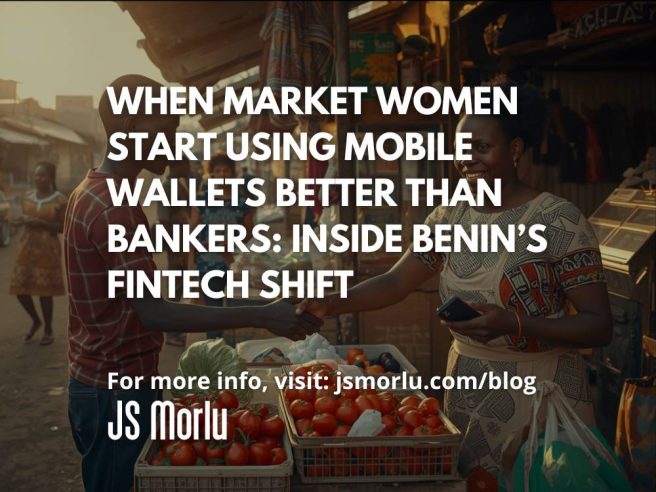
Fintech revolutions don’t always start in boardrooms with men in suits pointing at charts that claim a Total Addressable Market (TAM) of $10 billion. Sometimes, they start in open-air markets, where a woman selling tomatoes completes five digital wallet transfers before a banker remembers his USSD code.
In Benin, the fintech wave isn’t just being led by young coders with laptops—it’s also being powered by market women, moto-taxi drivers, micro-traders, loan collectors, and ordinary people who trust mobile transactions more than bureaucratic paper trails. In a country where trust is cultural currency and integrity has spiritual enforcement, the shift to digital money is not chaotic—it’s quietly natural.

1. Fintech Is Thriving Because Trust Came First
Most countries struggle with fintech adoption because people don’t trust digital systems. In Benin—a deeply relational society rooted in accountability and moral order—trust already sits at the heart of commerce. Cash transactions have long been built on handshake credibility, not legal disclaimers.
So when mobile money services emerged, people didn’t ask, “Can I trust this?” Instead, they asked, “Is it easier than handing over change during peak market rush?”
When the answer was yes, adoption became effortless.
2. Market Women: The Unofficial CFOs of Micro-Economies
In any Cotonou market, you may see a woman named Afi. She doesn’t wear a suit, but she knows her numbers. She knows how many regulars buy on credit, how many pay daily via mobile transfer, and which moto riders pay weekly.
She never attended a fintech workshop. Yet she can track rotating savings (tontine) contributions with a mobile wallet better than a banker can build an Excel sheet without breaking formulas.
She’s not “financially included”—she’s financially operational.
3. When Digital Money Feels Safer Than Cash
Carrying CFA cash on crowded streets attracts anxiety. But an e-wallet? That’s like carrying invisible cash—no pickpocket can snatch your phone number. For many small traders, especially women, mobile money is financial security plus convenience.
There’s also a cultural logic: if someone fails to repay a mobile-transfer debt, it’s traceable—meaning both social shame and potential spiritual consequences could follow.
This is fintech with moral backing.
4. Mobile Money Agents: The New Local Bank Branches
Benin’s local fintech ecosystem thrives because mobile money kiosks have replaced traditional bank counters for millions. An agent is not just a cash-in/cash-out point—they are:
- A community banker
- A financial translator
- A data-entry clerk
- A dispute resolver
- A neighborhood credit reference bureau
In rural and peri-urban spaces, the bank manager may be unknown. But the Moov or MTN mobile money agent is known—like a trusted neighbor.

5. The Cultural Psychology of Digital Trust
Fintech adoption in Benin isn’t just technical—it’s psychological. Consider a typical USSD transfer moment:
Sender: “Check if you’ve received it.”
Receiver checks phone.
Receiver nods calmly.
Deal sealed—no drama, no suspicion, no “Are you sure?”
Why so calm? Because digital proof carries social authority and, in many minds, possibly divine witness. In a culture where unseen accountability still exists, fraudulent denials feel spiritually dangerous.
6. Micro-Credit, BNPL, and the Coming Surge in Digital Lending
Once market women normalize daily transactions over mobile platforms, the next phase emerges naturally: credit scoring through transaction history.
This will lead to:
- Micro-loans based on wallet flows
- BNPL (Buy Now, Pay Later) adapted for informal trading
- Group savings management through digital tontine apps
- Automated contribution reminders that reduce social friction
In a trust-based society, recurring payments and collective finance tools will likely thrive faster than in distrust-heavy markets.
7. Why Fintech Startups Are Growing Calmly, Not Loudly
Unlike hyper-aggressive ecosystems where fintechs try to “burn money to acquire users,” Beninese fintech growth tends to be more stable. Startups build tools aligned with how people already trade—instead of imposing abstract concepts on daily life.
Rather than telling people to “change everything,” Beninese fintech firms ask:
- How do people already handle small payments?
- How can we digitize that without confusing them?
- How do we respect existing trust structures while adding speed and traceability?
That mindset leads to adoption without resistance.
8. When Simplicity Beats Silicon Valley Complexity
A Beninese fintech product may not have AI, blockchain, or NFTs shouting in its interface. But it works. And workability beats hype.
Investors are beginning to realize this: ecosystems that can convert market buyers into wallet users can later convert them into digital credit consumers—at scale.
Today, Afi is receiving payments via USSD.
Tomorrow, she may be approved for KpayoPay’s micro-trade credit line.
Next year, she might run her own rotating micro-lending group through an app.
All because she mastered: “Send 1,000 CFA to this number”—before most bankers stopped faxing documents.
9. Conclusion: When Culture, Commerce, and Code Align—Fintech Flourishes
In Benin, fintech isn’t a disruption. It’s an extension of existing trust flows. It scales because it respects market logic. It grows because it aligns with cultural rhythms. It sticks because people believe in it.
And when market women start using mobile wallets better than bankers? You’re not looking at early adoption. You’re looking at a financial transformation so natural it doesn’t even feel like innovation—it feels like progress with a SIM card.
Author: John S. Morlu II, CPA is the CEO and Chief Strategist of JS Morlu, leads a globally recognized public accounting and management consultancy firm. Under his visionary leadership, JS Morlu has become a pioneer in developing cutting-edge technologies across B2B, B2C, P2P, and B2G verticals. The firm’s groundbreaking innovations include AI-powered reconciliation software (ReckSoft.com), Uber for handymen (Fixaars.com) and advanced cloud accounting solutions (FinovatePro.com), setting new industry standards for efficiency, accuracy, and technological excellence.