
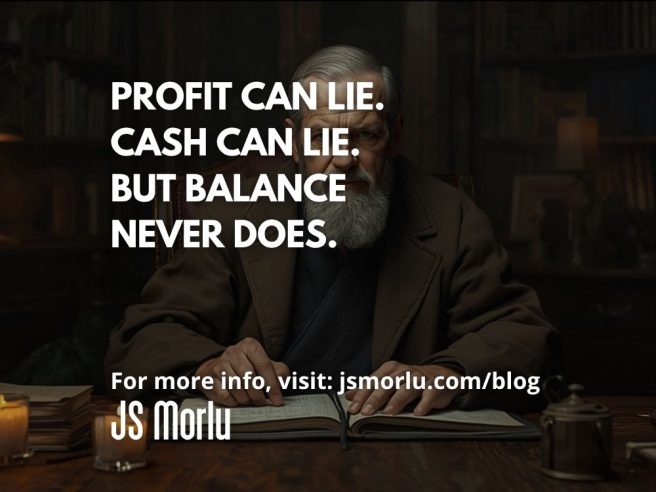
In every company, there are three storytellers: the income statement, the cash flow, and the balance sheet.
Two are dramatic, one is divine.
The income statement is the extrovert — loud, boastful, always performing for applause. “Look at our profits!” it shouts, waving numbers like trophies. The cash flow statement is the anxious realist — pacing in the corner, mumbling, “Yes, but do we actually have money?” And then there’s the balance sheet — calm, unsentimental, sitting in the back of the room like an old monk who’s seen it all.
It doesn’t exaggerate.
It doesn’t beg for attention.
It just tells the truth — even when no one wants to hear it.
The Most Honest Page in Business
Profit can lie. A few tweaks to revenue recognition, some aggressive expense timing, a bit of “creative” capitalization — and suddenly you look like a genius.
Cash can lie, too. You can delay vendor payments, speed up collections, or borrow just before year-end to make liquidity look heroic.
But balance?
Balance never lies.
Because the balance sheet doesn’t just record money — it records meaning. It’s the only statement that connects what you say with what actually exists.

The Illusion of Success
We once worked with a retail company that declared record profits — “Best year ever!” they said, popping champagne at the annual retreat. Their income statement sparkled. Their CEO’s LinkedIn headline read: “Leading a Record-Breaking Transformation.”
But then we opened the balance sheet.
Inventory up 60%.
Payables overdue.
Receivables growing faster than revenue.
They weren’t making money. They were just borrowing time.
Their profits were a magic trick: they recognized revenue before customers paid and delayed recording expenses.
The books said “success.”
The balance sheet said “slow-motion collapse.”
The CEO sighed when he saw it and whispered,
“So we’ve been performing, not progressing.”
Exactly.
The Psychology Behind the Lie
People lie when they’re afraid of the truth — and so do companies.
Profit is what they want to believe.
Cash is what they hope to control.
Balance is what they actually are.
The balance sheet is brutally indifferent to ego. It doesn’t care about intentions, slogans, or shareholder letters. It simply asks, “After everything, what remains?”
It’s not emotional — but it’s deeply moral.
Because balance, by nature, is ethical.
It demands equality.
It demands reconciliation.
It demands you admit what you owe and what you own.
That’s not accounting — that’s philosophy.
Example: The Startup That Thought It Was Rich
A startup once bragged about a $1 million profit. They were expanding, hiring, celebrating. But when we reviewed their balance sheet, we found they were sitting on $900,000 in unpaid invoices and $300,000 in credit card debt.
Their “profit” was fictional — they were profiting on promises.
We told the founder,
“You’re not profitable. You’re just popular — with your creditors.”
They laughed nervously.
Then reality hit like a bank statement.
How Cash Lies Too
Cash is often used as the ultimate “truth” metric — but even cash can manipulate perception. A company can delay paying suppliers, liquidate assets, or pull short-term loans just to look flush on paper.
It’s financial makeup — looks good in the photo, bad in the morning.
We once found a client who kept “healthy” cash reserves by not paying their vendors for 90 days.
Their cash looked great.
Their reputation didn’t.
Cash flow may reveal timing, but it doesn’t reveal truth. Only balance can tell you whether the cash came from strength or desperation.
The Law of Financial Gravity
There’s a universal rule in accounting:
the truth always lands in the balance sheet.
You can disguise losses on the income statement.
You can mask liquidity issues in cash flow.
But the balance sheet quietly gathers evidence.
Every bad decision ends up there eventually — sometimes as debt, sometimes as depletion, sometimes as regret.
It’s the place where ambition meets arithmetic.
Where integrity is weighed — literally.
The Historical Example: Enron’s Ghost
Enron’s income statement sparkled.
Its executives won awards.
Analysts called it revolutionary.
But the balance sheet was quietly rotting — over-leveraged, full of hidden liabilities and off-book entities. When it collapsed, the world was shocked.
The balance sheet wasn’t.
It had been honest the entire time.
The Metaphor of Life
In life, as in accounting, everything looks good until the reconciliation. Your income statement is what you post on social media — highlights, achievements, curated wins. Your cash flow is your daily energy — some days high, some days empty.
But your balance sheet? That’s your soul.
It’s who you are when no one’s watching.
What you’ve built, what you owe, what truly belongs to you.
And just like in business, your real stability doesn’t come from how much you make — but from how much you’ve balanced.

Example: The HOA That Finally Balanced the Books (and Itself)
An HOA we advised once spent years boasting about “strong reserves.” Until an audit revealed those reserves existed mostly in Excel, not in the bank. They’d been transferring funds between accounts to make things “look stable.”
When we corrected it, their treasurer admitted,
“We were pretending to be okay. The numbers just told on us.”
Within months, the board restructured budgets, raised transparency, and built real reserves. By the next year, they didn’t just have balance — they had credibility.
The JS Morlu Lesson
At JS Morlu, we’ve learned to love the quiet honesty of balance sheets. They don’t panic, flatter, or hide behind trends. They simply sit there — factual, composed, and consistent — like an old accountant watching the world spin itself into optimism.
We trust them more than we trust words.
Because they never betray what’s real.
Moral of the Story
Profit can lie — because performance loves exaggeration.
Cash can lie — because liquidity can be borrowed.
But balance never lies — because truth can’t be leveraged.
The companies that last aren’t the loudest or the richest. They’re the ones whose books — and consciences — reconcile at the same time.
Final Line
Profit is opinion. Cash is timing. Balance is truth.