
By: John S. Morlu II, CPA
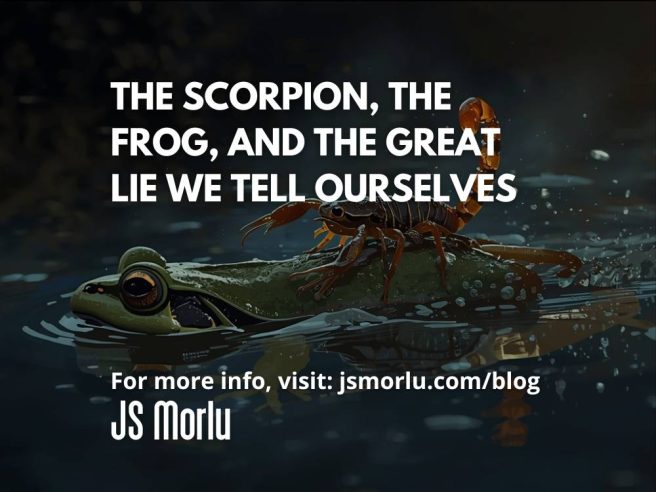
Everyone knows the story. A scorpion wants to cross a river. A frog hesitates. The scorpion promises not to sting. Midway across, the scorpion stings anyway. Both drown.
“Why?” the frog gasps. “Because it’s my nature,” says the scorpion.
This story is usually told to children as a warning. It should really be told to adults as an indictment. Because by adulthood, most people have heard this story, nodded solemnly, and then proceeded to ignore it for the rest of their lives—especially in business, politics, relationships, and leadership.
What follows is what happens when five of history’s most uncomfortable thinkers walk into this river and refuse to look away.

1. Machiavelli: “You Shouldn’t Have Been on the Frog”
Machiavelli would not waste time moralizing the scorpion. He would look at the frog and sigh. “The error was not trusting a scorpion. The error was believing trust had anything to do with survival.”
To Machiavelli, the scorpion didn’t betray the frog. The frog misread power dynamics.
Fun fact: The Prince was never meant to teach evil—it was meant to describe it accurately. Machiavelli didn’t invent cynicism; he simply removed illusions.
In Machiavelli’s world:
- Promises are tools, not contracts.
- Nature beats intention.
- Naivety is not virtue—it’s exposure.
The frog thought morality would restrain biology. Machiavelli would call that strategic illiteracy. The lesson isn’t “don’t trust.” The lesson is: never outsource your survival to someone else’s character.
2. Carl Jung: “You Ignored the Shadow”
Jung would lean closer to the riverbank, fascinated. “The scorpion did not betray you. Your denial betrayed you.”
Jung believed every human carries a shadow—the part of ourselves we refuse to acknowledge. The scorpion knows its shadow. The frog refuses to see it.
Here’s the uncomfortable part: the frog needed to believe the scorpion was safe. Why? Because acknowledging danger would require boundaries—and boundaries require courage.
Interesting tidbit: Jung believed people are most dangerous when they believe they are harmless.
The frog projected goodness onto the scorpion because it wanted harmony more than truth. Jung would say the frog drowned not because of malice, but because of psychological avoidance.
In modern terms:
- “He wouldn’t do that to me.”
- “She didn’t mean it like that.”
- “I know his history, but I’m different.”
That’s not compassion. That’s shadow blindness.
3. Dostoevsky: “Everyone Wants to Be Innocent”
Dostoevsky would not condemn the scorpion either. He would stare at the frog and whisper: “You wanted to be innocent more than you wanted to live.”
Dostoevsky understood something terrifying: people prefer moral purity to responsibility. The frog wanted to believe in goodness because it wanted to be good. It wanted the story where kindness triumphs, where suffering has meaning, where virtue saves.
But Dostoevsky knew: human beings often choose suffering if it preserves their self-image.
Fun fact: Dostoevsky believed humans will act against their own interest simply to prove they are free.
The frog didn’t just trust the scorpion. The frog chose a narrative where trust was heroic—and that narrative drowned it.

4. Nietzsche: “Your Morality Is Why You’re Dead”
Nietzsche would laugh. Not cruelly—almost sadly. “You died because you mistook weakness for virtue.”
Nietzsche despised moral systems that reward self-sacrifice without wisdom. He believed many moral codes exist not to elevate humanity, but to justify fragility. The frog’s problem was not kindness. It was unexamined kindness.
Fun tidbit: Nietzsche argued that moral frameworks often protect the dangerous by restraining the capable.
The frog’s morality told it:
- Give everyone a chance.
- Believe in promises.
- Don’t judge.
Nietzsche would reply:
- Judge accurately.
- Choose strength with awareness.
- Stop romanticizing trust.
The scorpion was honest about what it was. The frog was dishonest about reality.
5. Schopenhauer: “This Was Inevitable”
Schopenhauer wouldn’t argue at all. He would simply nod. “Of course it happened. Suffering is the default setting.”
Schopenhauer believed human existence is driven by blind will—not reason, not goodness, not progress. The scorpion stung because desire overrides logic. The frog trusted because hope overrides evidence.
Interesting tidbit: Schopenhauer believed compassion arises not from morality, but from recognizing shared suffering.
But even compassion has limits. To Schopenhauer, the tragedy isn’t betrayal—it’s expectation. Expect less. Observe more. Detach earlier. The frog expected a different outcome because it wanted one. Nature did not care.
The Modern River (Where This Story Actually Happens)
This story is not about animals. It’s about:
- Founders who trust partners with clear patterns.
- Leaders who promote charm over competence.
- Nations that negotiate with ideologies that announce their intentions.
- Lovers who ignore consistent behavior in favor of potential.
Fun modern fact: Psychologists say past behavior is the single strongest predictor of future behavior—yet people routinely treat it as “background noise.”
Why? Because believing people will change is emotionally cheaper than enforcing boundaries. Until it isn’t.
The Final Truth (No One Likes)
The scorpion didn’t kill the frog. The frog drowned itself by:
- Ignoring patterns.
- Romanticizing intention.
- Confusing morality with wisdom.
- Valuing hope over evidence.
The scorpion simply finished the sentence the frog started.
Closing Line (Machiavelli Would Approve)
Not everyone who harms you is evil. Not everyone who trusts you is wise. And the most dangerous lie ever told is: “This time will be different.”
The river is still full of frogs. The scorpions are not hiding. They never were.
Author: John S. Morlu II, CPA is the CEO and Chief Strategist of JS Morlu, leads a globally recognized public accounting and management consultancy firm. Under his visionary leadership, JS Morlu has become a pioneer in developing cutting-edge technologies across B2B, B2C, P2P, and B2G verticals. The firm’s groundbreaking innovations include AI-powered reconciliation software (ReckSoft.com), Uber for handymen (Fixaars.com) and advanced cloud accounting solutions (FinovatePro.com), setting new industry standards for efficiency, accuracy, and technological excellence.