
By: John S. Morlu II, CPA
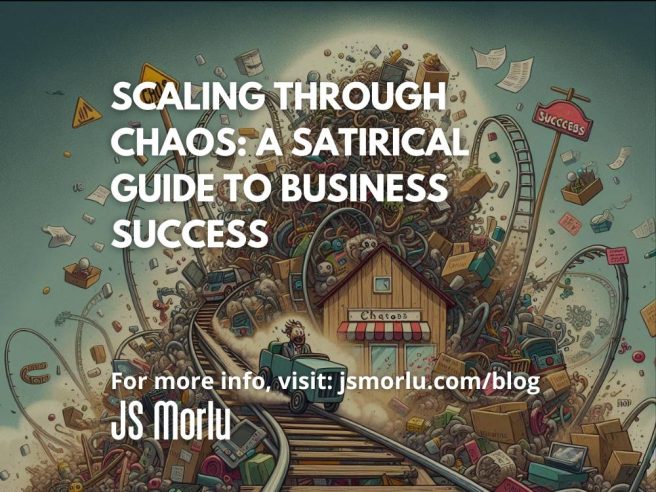
Welcome to the dizzying world of “scaling,” a thrilling yet treacherous journey that transforms a modestly successful business into an ambitious enterprise poised for greatness. At first glance, scaling seems like the ultimate goal—an exciting venture into uncharted territories, where possibilities abound, and the horizon is filled with promise. However, the reality can often be far more chaotic. It’s where you take a business that’s already working just fine, throw in a blizzard of ambitious plans, and hope it survives the storm of complexities that follow.
As any seasoned entrepreneur will tell you, scaling isn’t merely about increasing sales or expanding your product line; it’s a multifaceted challenge that tests the very foundations of your business. It demands strategic foresight, operational agility, and a deep understanding of your market—all while navigating the inevitable growing pains that come with ambitious growth. The allure of scaling can quickly become a double-edged sword; it can propel your company to new heights, but it can also plunge it into disarray if not handled with care.
That’s where our fictional guide comes in. In this satirical exploration of scaling, we’ll introduce you to a cast of eccentric characters and whimsical companies, each embodying the humorous yet poignant lessons learned along the way. Through their misadventures, we’ll dissect the common pitfalls and blunders that befall many aspiring scale-ups. Expect a blend of insightful commentary and light-hearted storytelling, where the absurdity of their experiences shines a light on the essential principles of sustainable growth.
Join us as we navigate the complexities of scaling—complete with a healthy dose of common sense. With a keen eye for humor and an unflinching look at the realities of business growth, this guide aims to equip you with the knowledge to pursue scaling strategically, helping you avoid the pitfalls that ensnared our fictional friends. Whether you’re an entrepreneur at the helm of a budding startup or a seasoned executive at an established firm, this exploration will resonate with anyone grappling with the challenges of growth. Let’s dive in and discover the rollercoaster ride of scaling, where every twist and turn offers valuable lessons and a few hearty laughs along the way.

Chapter 1: The Story of Bungle & Fumble, LLC
Meet Bungle & Fumble, LLC, the quirky enterprise that started with a simple idea: selling custom-made socks. Not just any socks, but whimsical, personalized socks that catered to niche markets. From rainbow socks for Pride Month to avocado-patterned socks that delighted millennials, and even socks embroidered with tiny cats for devoted cat enthusiasts, Stan Bungle and Fran Fumble had struck gold in the sock market.
Initially, the small team operated smoothly, fostering a loyal customer base that appreciated thoughtful design and unique offerings. Stan and Fran were content with their modest success, enjoying the camaraderie of their close-knit team and the creative freedom that came with a small business.
However, one fateful day, Stan stumbled across a TED Talk on scaling, delivered by a speaker whose unbuttoned shirt and exaggerated enthusiasm captivated him. The speaker waxed poetic about the glamorous journey from “small business to conglomerate,” boasting tales of entrepreneurs who transformed their humble startups into global empires. Enchanted by the idea of exponential growth, Stan returned to the office with a feverish ambition to expand.
In a rush of adrenaline, Stan proposed diversifying their product line: “Why stop at socks? Let’s sell customized slippers! Eco-friendly shoe insoles! Luxury shoelaces for those special occasions!” Fran hesitated but soon caught the vision of endless possibilities. Before they knew it, Bungle & Fumble had morphed into a sprawling operation, selling everything foot-related and racing toward a chaotic existence.
Suddenly, their manageable, fun business had transformed into a full-blown circus, filled with mismatched product launches and a mounting inventory crisis. The sock-focused camaraderie that once thrived was replaced by confusion and overextension.

Chapter 2: The Rise of Haphazard Inc.
In a neighboring city, the equally ambitious but slightly more chaotic Haphazard Inc. emerged. Founded with a singular mission—to sell mugs adorned with quirky, inspirational affirmations like “This Mug Gets Me” and “Coffee, Because Adulting”—Haphazard was a hit among caffeine enthusiasts. Their slogan, “Mugs to Brighten Your Day, or at Least Not Make It Worse,” resonated with many.
Their mugs flew off the shelves, and soon, like Bungle & Fumble, they too succumbed to the seductive allure of scaling. Instead of simply expanding their mug collection, they thought, “Why stop at mugs? Let’s introduce T-shirts! Tote bags! Why not artisanal bookmarks made from sustainable bamboo?” Their aspirations were grand, yet execution was haphazard, leading to an assortment of mismatched products that left customers perplexed.
As they attempted to juggle their growing catalog, they faced a significant reality check. Fun fact: research shows that more than 60% of businesses that “scale” experience a significant dip in customer satisfaction because they forget the cardinal rule: more products mean more problems. This lesson hit home for Haphazard when customers began receiving “This Mug is Lit” products with cracks, resulting in unfortunate coffee accidents and scathing online reviews. The charm of quirky affirmations became overshadowed by customer disillusionment, leading Haphazard Inc. down a slippery slope.

Chapter 3: The Meeting Marathon Phenomenon
With the chaotic expansion came a new tradition for both Bungle & Fumble and Haphazard: The Endless Meeting Marathon. Meetings became the lifeblood of the organizations, overshadowing actual work and leading to extreme fatigue among employees.
Here’s a typical Monday schedule:
- 9:00 am: “Scaling Strategy” (a vague title that sounded serious but left everyone confused)
- 10:00 am: “Alignment Across Teams” (where no one knew what they were aligning to)
- 11:00 am: “Deep Dive into Growth Metrics” (a deep dive involving very shallow insights)
By noon, teams were thoroughly exhausted and none the wiser, fully prepared to dive into…yet another meeting. Somewhere between all the “alignment” and “deep dives,” actual work had become an endangered species.
As our friends at Bungle & Fumble and Haphazard Inc. soon realized, meeting marathons were productivity killers. Studies show that over 70% of employees report feeling “profoundly unmotivated” by excessive meetings, while another 30% feigned technical difficulties to skip them entirely.
Common sense tip: If you’re spending more time discussing what you’re going to do than actually doing it, your scaling strategy is probably headed for trouble.

Chapter 4: The Power of Pointless Data
Scaling brought an overwhelming obsession with data to both companies. Every decision seemed to hinge on becoming “data-driven.” At Bungle & Fumble, they invested in software to track every conceivable click, keystroke, and mouse movement on their website. They monitored analytics for sock sales, customer feedback on patterns, and even sock durability in various climates. One intern tasked with “customer insights” unearthed an alarming discovery: customers from Nebraska were twice as likely to purchase avocado socks on Thursdays than any other day of the week. No one knew why, but that didn’t stop them from hosting a meeting to discuss it.
Meanwhile, Haphazard Inc. employed a full-time “Data Wizard” who built complex dashboards with interactive graphs, real-time updates, and even a temperature-sensitive chart that fluctuated based on the weather in Finland, because why not? Eventually, the dashboard became so intricate that it required a user manual, which no one bothered to read.
Fun fact: Only 37% of data collected by companies is ever utilized in decision-making. The other 63%? Just a great excuse for more meetings.
Lesson: Instead of drowning in data, focus on key insights. As our fictional friends learned, it’s better to understand one meaningful metric than to obsess over a thousand useless ones.

Chapter 5: The Rise of “Innovative” Titles
One delightful aspect of scaling is the explosion of unique and borderline absurd job titles. Bungle & Fumble expanded their team and proudly introduced a Chief Sock Synergy Officer (who didn’t quite know what “synergy” meant) and a Director of Cozy Optimization (whose primary role involved organizing coffee breaks and stockpiling free granola bars).
Haphazard Inc. followed suit, appointing a Growth Hacker-in-Residence and a Customer Experience Curator. The Growth Hacker, known in reality as Frank from Accounting, suggested they “go viral on TikTok” by filming the world’s first mug balancing contest. Meanwhile, the Customer Experience Curator’s only job was to respond to one-star Yelp reviews with the standard “We’re sorry you feel that way.”
Studies reveal that an increase in vague job titles correlates with an increase in corporate confusion. Common sense says that calling someone a “Ninja” doesn’t make them skilled at their job, and giving them the title “Vision Czar” doesn’t magically grant them foresight. But scaling companies love fancy titles, even if it leaves everyone guessing about who does what.

Chapter 6: The Great Automation Overload
Now we reach the glorious land of automation, a beloved concept for scaling companies everywhere. Bungle & Fumble installed an automated email responder that sent out cheerful messages like, “Thank you for reaching out! We will respond in the next 24 hours,” yet somehow, they never actually did respond. Their automated FAQ bot added insult to injury, responding to refund inquiries with, “Thank you for your enthusiasm for Bungle & Fumble socks!”
Haphazard Inc. wasn’t far behind. They launched a customer service chatbot named “Helpy,” designed to handle even the simplest inquiries. A straightforward question like “Can I change my order?” prompted Helpy to cheerfully reply, “We hope you love our mugs! Keep sipping!”
Fun fact: In a recent survey, 45% of customers indicated they would rather wait longer to talk to a real person than engage with an unhelpful bot. So much for the wonders of automation.
Common sense: Automate what enhances the customer experience, not what drives them away in frustration.

Chapter 7: The Blame Game: A Fun Company Tradition
As Bungle & Fumble scaled, so did their newfound ability to shift blame. When orders were delayed or mismatched socks were delivered, it was never clear whose fault it was. They labeled it as “a fulfillment issue” or “a communication gap.” Somewhere along the line, they even blamed the Wi-Fi. At Haphazard, when a batch of mugs that should have read “World’s Greatest Dad” turned up as “World’s Greatest Sad,” they attributed it to “a minor translation error.”
Studies show that scaling often increases confusion, making it difficult to trace issues back to their root cause. It becomes easier to form a “Blame Committee” and draft a document titled “Lessons Learned (But Mostly Ignored).”

Chapter 8: Scaling Back, or as Bungle & Fumble Put It, “Oops, Maybe Not”
After a year of scaling chaos, both Bungle & Fumble and Haphazard Inc. underwent a much-needed reckoning. Customers missed the old days when their offerings were straightforward and centered around socks or mugs. Meanwhile, Haphazard’s CEO faced a growing mountain of complaints regarding unfulfilling customer experiences.
Realizing their scaling attempts had led to spiraling chaos, they regrouped. Their epiphany? Scaling doesn’t equal success—sometimes, it’s best to scale back, focus on what you do well, and ensure customer satisfaction before attempting to conquer the world.

Chapter 9: The Satirical Takeaway
As we reach the conclusion of our whimsical journey through the often-chaotic world of scaling, it’s clear that this venture doesn’t have to devolve into a dizzying spiral of confusion and disorder. Our comical protagonists, Bungle & Fumble and Haphazard Inc., discovered that the keys to navigating the tumultuous waters of growth lie in some surprisingly straightforward principles. By maintaining focus, simplifying operations, prioritizing customer needs, and harnessing the power of data-driven insights, they laid a solid foundation for sustainable growth that could weather any storm.
Scaling can indeed be ambitious and exhilarating, often accompanied by a whirlwind of activity and change. However, at the core of every successful business lies an essential truth: understanding your customers is paramount. It’s about staying true to your core offerings, delivering consistent value, and ensuring that in the mad dash for growth, the fundamental elements of your business don’t get lost in the shuffle.
This chapter serves as a poignant reminder that while the allure of expansion can be intoxicating, the real magic happens when businesses take a step back and ground themselves in what truly matters. By focusing on the essentials, aspiring entrepreneurs can turn the chaos of scaling into a harmonious symphony of growth and innovation.
So now, go forth, aspiring entrepreneurs! Carry with you the absurdity and humor woven throughout this guide as a beacon of wisdom. Let it remind you that in the pursuit of greatness, sometimes less truly is more. Embrace simplicity, nurture your customer relationships, and keep your core values at the forefront of your strategy. The road ahead may be filled with twists and turns, but with these principles in hand, you’ll be well-equipped to navigate the wild ride of scaling.
Author: John S. Morlu II, CPA is the CEO and Chief Strategist of JS Morlu, leads a globally recognized public accounting and management consultancy firm. Under his visionary leadership, JS Morlu has become a pioneer in developing cutting-edge technologies across B2B, B2C, P2P, and B2G verticals. The firm’s groundbreaking innovations include AI-powered reconciliation software (ReckSoft.com), Uber for handymen (Fixaars.com) and advanced cloud accounting solutions (FinovatePro.com), setting new industry standards for efficiency, accuracy, and technological excellence.