
By: John S. Morlu II, CPA
Most people try to look successful. Very few try to become institutionally undeniable — and there is a difference.
A luxury watch can signal wealth. A viral post can signal attention. A fancy office can signal status. But none of those things automatically signal civilizational weight.
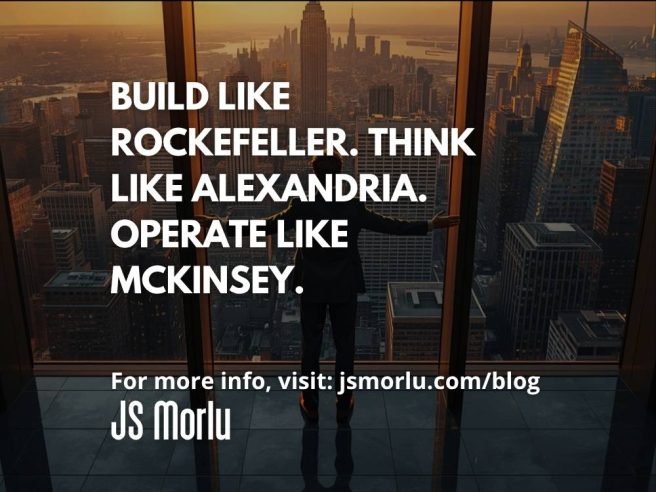
The people and organizations that permanently elevate their reputation usually combine three things: infrastructure power, intellectual power, and execution discipline. That is essentially what the following framework describes — Rockefeller infrastructure, McKinsey-class discipline, and Alexandria intellectual prowess. That combination is rare because it requires substance across multiple dimensions, not just image.

1. Rockefeller Infrastructure: Build Systems Bigger Than Personalities
John D. Rockefeller did not become powerful because he was loud. He became powerful because his systems became unavoidable — pipelines, distribution, refining, rail leverage, operational standardization, capital allocation, and scale efficiency.
The lesson is not “be ruthless.” The lesson is: build infrastructure that other people quietly depend on. That is reputation at the highest level. Not applause — dependence.
For strategic positioning, this means building platforms instead of services, ecosystems instead of projects, standards instead of opinions, and operating systems instead of temporary solutions. That is why FinovatePro matters more than bookkeeping, Recksoft matters more than reconciliation consulting, and academy ecosystems matter more than training workshops.
Infrastructure elevates reputation because infrastructure survives moods, trends, and personalities. People respect what they cannot easily replace.
2. McKinsey-Class Discipline: Elite Precision, Discipline, and Presentation
McKinsey & Company became powerful partly because of perception — but perception built on disciplined execution. McKinsey-class positioning means structured thinking, precise communication, executive-level framing, consistent quality, intellectual confidence without emotional noise, and reliable delivery.
The world associates elite organizations with clarity, rigor, composure, and repeatability. That means emails, proposals, meetings, decks, manuals, software interfaces, contracts, audit files, and even internal workflows must feel coherent. Powerful reputation is cumulative — every small interaction either strengthens institutional trust or weakens it.
People notice formatting, responsiveness, organization, language precision, meeting structure, consistency, and operational calm. The elite world is quietly obsessed with operational polish — not because polish alone matters, but because polish signals control.

3. Alexandria Intellectual Prowess: Become a Living Library
The Library of Alexandria became legendary because it symbolized concentrated human knowledge. Intellectual reputation today is not about sounding smart. It is about synthesis, depth, pattern recognition, and interdisciplinary thinking.
The modern intellectual elite can connect economics, psychology, technology, accounting, governance, incentives, systems, geopolitics, and human behavior. Most people memorize information. High-level thinkers connect realities.
A person with true intellectual presence walks into a room and simplifies complexity, sees second-order effects, predicts consequences, explains incentives, and structures chaos calmly. That creates gravity — not performative intelligence, but applied intelligence.
4. The Dangerous Mistake: Trying to Look Elite Instead of Becoming Elite
Many people try to shortcut reputation. They invest in luxury, titles, followers, visibility, and proximity — mistaking the appearance of sophistication for the substance of it. But reality audits everyone eventually. The bridge must stand. The software must work. The numbers must reconcile. The strategy must survive stress.
Reality is the final reputation manager. That is why enduring reputation comes from capability, systems, judgment, and consistency — not performance art.
5. The Formula for Institutional Reputation
Rockefeller Infrastructure + McKinsey Discipline + Alexandria Intelligence + Relentless Execution + Ethical Restraint = Institutional Reputation.
Not influencer reputation — institutional reputation. Influencers chase visibility. Institutions shape reality.
The highest form of reputation is not being admired; it is being trusted at scale. Admiration is emotional. Trust is economic. When governments, banks, clients, teams, investors, and institutions trust you, that is where true power begins.
And ironically, the people who reach that level usually become quieter, calmer, and more disciplined — because they understand something most people never learn: real power does not need constant advertisement. It becomes visible through structure, consistency, and outcomes.
Author: John S. Morlu II, CPA is the CEO and Chief Strategist of JS Morlu and leads a licensed public accounting and management consultancy firm. He has more than 20 years of professional experience in auditing and advisory work, including service as Auditor General of Liberia and FAR and DCAA compliance work at Unisys Federal Systems. The firm’s technology products include AI-powered reconciliation software (ReckSoft.com), a handyman services platform (Fixaars.com) and advanced cloud accounting solutions (FinovatePro.com), built for finance and operations teams.