
By: John S. Morlu II, CPA
The stock market is a curious beast—equal parts financial playground, gladiator arena, and magician’s stage, where fortunes are built and erased with the flick of a trade, and the impossible often seems to happen before your very eyes. In this arena of high stakes and fierce competition, there are winners and losers, but also those who seem to defy the very rules of the game. It’s a world where success can come overnight, fortunes can vanish in the blink of an eye, and—if you’re clever enough—you can control an entire empire without actually owning much of it.
Among the most fascinating tricks pulled off in this world is the “dual-class share” structure, a brilliant yet controversial financial maneuver that allows founders and a select few to hold on to power—often indefinitely—while selling off large portions of their companies. Think of it as the corporate version of having your cake and eating it too, except you also get to keep the bakery. This structure has produced some of the most riveting and head-scratching stories in the world of corporate governance, where the balance of power is delicately engineered to favor the few, no matter how much the many may invest.
But make no mistake, this isn’t just a niche financial quirk—it’s a key ingredient in the rise of some of the biggest, most influential companies in the world. From tech giants to media empires, the use of dual-class shares has enabled founders to maintain control long after they’ve cashed in on their success, steering their companies with singular vision (and sometimes ego) while investors are left holding stock with limited voting power.
It’s a system designed for founders to retain control, whether the company flourishes or falters. In this world, investors might supply the capital, but it’s the founders who hold the keys to the kingdom. Whether you think that’s a genius move or a breach of shareholder democracy, one thing is certain: dual-class shares are changing the way modern corporations are run—and they’ve become a lightning rod for debate in boardrooms and among investors.
So, why do some of the world’s most powerful companies, from tech titans like Meta (formerly Facebook) to media powerhouses like The New York Times, swear by dual-class shares? And why are more investors clamoring for “sunset clauses”—a ticking clock on how long founders can maintain their iron grip on the companies they once started?
We’re about to take a deep dive into a world where control isn’t just a goal—it’s an obsession. A place where founders of startups morph into modern-day emperors, ruling over their corporate empires with little regard for the voices of the common shareholders. You’ll see how, in the jungle of the stock market, dual-class shares are the predator at the top of the food chain—allowing the powerful to thrive with very little ownership while the masses can only hope for the occasional dividend.
If you’ve ever been curious about how some of the world’s most iconic CEOs—like Mark Zuckerberg, Larry Page, or Jack Ma—manage to hold onto their power with so little actual stock in their companies, you’re in for a wild ride. Grab your popcorn (maybe even a calculator), settle in, and let’s journey into the fascinating, sometimes bewildering, and always controversial world of dual-class shares. You’ll learn how this corporate structure works, why it’s beloved by some, despised by others, and how it’s reshaping the corporate landscape across industries—from tech to media to manufacturing.
By the time we’re done, you’ll not only understand how the rich and powerful stay in control, but you might also have a few chuckles along the way. After all, in the world of dual-class shares, irony and intrigue are never far behind. Ready? Let’s dive in.

Chapter 1: What Are Dual-Class Shares?
Before we venture into the zany world of corporate hijinks, let’s start by defining the villain of our story: dual-class shares. Think of it like showing up to a potluck where everyone brings something to the table. You walk in with your carefully prepared side dish, and as you find a seat, you realize the host has a golden spoon and can eat 10 times more than everyone else, while you’re stuck with a plastic fork and a single nibble. Welcome to dual-class shares: where not all shareholders are created equal.
In this setup, companies issue two (or more) types of stock, most commonly labeled as Class A and Class B. The catch? The voting power between them is as lopsided as your family’s Thanksgiving debate about politics. Class A might offer you one humble vote per share, while Class B—reserved for founders, insiders, or corporate royalty—could wield 10 votes per share. It’s like trying to argue with someone on Twitter who has a megaphone while you’re whispering into a pillow.
Case Study: Facebook (Meta)
Take Mark Zuckerberg, for example. He owns just a slice of Meta’s stock pie, but with his special Class B shares, he’s practically running a corporate monarchy. Mark has 10 votes per share, and the rest of the investors are left with one. It’s like inviting you to a company picnic, but Zuck gets to pick the music, food, and whether you even get a plate.
In Zuckerberg’s world, shareholders are like enthusiastic soccer fans watching a game—they can cheer, they can boo, but when it comes to making plays on the field, they might as well be in the parking lot.
In Summary: Dual-class shares are like being invited to a wedding where you pay for your meal, but only the bride and groom get to decide the venue, the menu, and whether you’re seated next to Aunt Karen.

Chapter 2: The Purpose—When You Want to Sell but Still Control
Ah, the sweet allure of dual-class shares: selling stock without losing control. It’s like pawning off your house to raise money but keeping the key to the front door—and the deed—and, while you’re at it, making sure you still get to choose what color to paint the living room.
This structure is perfect for founders who want to swim in a pool of public capital but don’t want anyone else peeking at the pool filter. They want the investment, the cash, the market validation—but when it comes to who’s in charge, it’s still very much their show. Imagine being able to quit your job, but still have the power to boss your replacement around. Neat, huh?
Example #1: Alphabet (formerly Google)
Larry Page and Sergey Brin of Google fame were way ahead of the curve. When they took Alphabet public, they made sure to retain full control with their super-voting Class B shares. They might have sold off shares to the public, but in the boardroom, it’s still their ballgame. In fact, they can choose who gets to sit on the bench and who even gets to watch.
For Alphabet’s shareholders, it’s like buying a Ferrari but being told you can only drive it on weekends—and even then, only in reverse.
Example #2: Snap Inc.
And then there’s Snap Inc., the company that took this whole concept to an even more absurd level. When they went public, they told investors, “Hey, give us your money, but you get no votes.” Zero. Nada. Imagine paying for a ticket to a concert where the band gets to decide whether you even hear the music. Snap’s IPO was basically that. But hey, as long as your Snapchat streak is alive, right?
Example #3: Ford
Even Ford, the classic American automaker, isn’t immune to the allure of dual-class shares. The Ford family, thanks to their magic shares, owns a measly 4% of the company but controls 40% of the voting power. It’s like being part of a democracy where one person gets 10 votes because their great-great-grandfather built the town’s first saloon. Nepotism? Sure. Genius? Absolutely.

Chapter 3: Why Investors Are Getting (Very) Annoyed
If you’ve ever been stuck in traffic, late for a meeting, honking at the car ahead of you with no effect whatsoever, you already know how shareholders of dual-class companies feel. Investors—who, let’s not forget, are ponying up actual cash—are getting increasingly frustrated with these setups. They might own a big slice of the company, but it turns out their voice at the table is more like a polite suggestion.
This is why “sunset clauses” are becoming popular. These clauses are like expiration dates for founder control. Essentially, after a certain number of years (usually five to ten), the founder’s extra voting power disappears. Think of it like a carton of milk in the fridge—eventually, it’ll go bad, and at that point, everyone’s got to find a new breakfast plan.
Example #4: Pinterest
Pinterest saw the writing on the wall and decided to be (somewhat) fair. They implemented a sunset clause, meaning that after seven years, the founders’ extra voting power would dissolve like one of those fancy bath bombs. Shareholders might finally get their say—although by then, they’ll probably have forgotten which boardroom battle they were fighting in the first place.
Example #5: Lyft
Lyft’s founders also added a sunset clause to their dual-class structure. In seven years, the founders will have to hand over the reins. Until then, it’s their world and the investors are just hailing rides, hoping they don’t get charged a surge price when their patience runs out. It’s basically like being promised that one day, after enough time and frustration, you’ll get the chance to actually steer the ship. Maybe.

Chapter 4: The Tech World’s Love Affair with Dual-Class Shares
If dual-class shares were a dating app, Silicon Valley would be swiping right on them every time. For tech founders, it’s the perfect match: total control over their companies, even after they’ve sold off chunks of it to the public. In the tech world, maintaining “the vision” (or, let’s be honest, the control) is sacred. Shareholders? They’re just along for the ride, hopefully enjoying the scenery while the founders steer wherever they please.
Example #6: Airbnb
Picture this: You’re booking a weekend getaway on Airbnb. You find a charming little cabin, click “reserve,” and head off to enjoy nature. Meanwhile, Airbnb’s co-founders are enjoying their weekend, knowing they control the fate of the company with their Class B shares, each packing 10 votes. While you’re deciding between s’mores or hiking, they’re deciding on the future of the platform without needing your input. It’s a beautiful system—if you’re them.
Example #7: Spotify
Spotify might let you skip songs, but it sure doesn’t let shareholders skip founders’ control. Daniel Ek and Martin Lorentzon, the streaming service’s co-founders, maintain their iron grip on the company with—you guessed it—dual-class shares. So, while investors might have all the indie playlists they could dream of, when it comes to major company decisions, Ek and Lorentzon are the ones calling the tunes.
Example #8: Alibaba
And let’s not forget Alibaba. When Jack Ma took the Chinese e-commerce giant public, he made sure a small group of insiders (spoiler alert: him and his buddies) got to nominate the majority of the board. It’s like being invited to a poker game where you’re only allowed to bet on how many snacks the dealer eats while they shuffle the cards. Investors are part of the story, but when it comes to writing the ending, Ma has the final word.
Chapter 5: Fun Fact Interlude
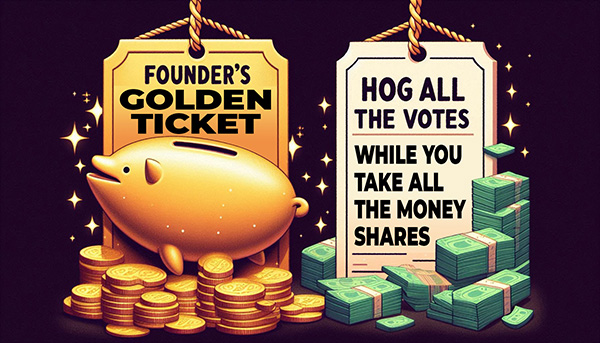
Let’s take a breather from all this serious talk about corporate governance and get into some fun trivia! Did you know that dual-class shares almost had a much more descriptive name? If honesty had won out, they might’ve been called “Founder’s Golden Ticket Shares” or maybe even “Hog All the Votes While You Take All the Money” shares. Okay, that’s not true—but it definitely feels like it sometimes.
Example #9: 23andMe
23andMe might help you find out where your ancestors came from, but when it comes to having a say in the company’s future, don’t hold your breath. CEO Anne Wojcicki made sure she kept full control of the company with her special Class B shares. So while you’re out here learning about your 14th cousin thrice removed, Wojcicki is deciding 23andMe’s future without needing your DNA—or your vote.
Chapter 6: The Media Gets in on the Action
Tech isn’t the only industry in love with dual-class shares. Media companies also want a piece of the action, and why wouldn’t they? If you control the narrative, it’s only logical to want to control the boardroom, too.
Example #10: The New York Times
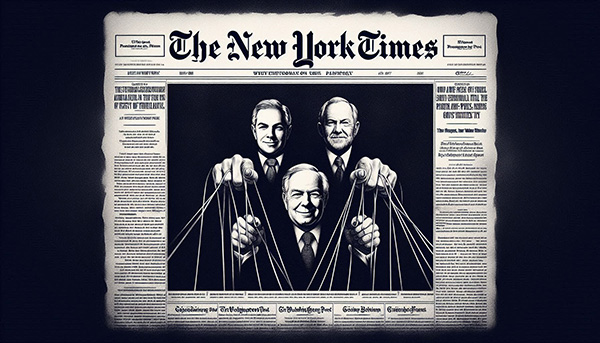
The New York Times has been a trusted voice in journalism for over a century, but did you know that the Sulzberger family has been the puppet masters behind the scenes for almost as long? Thanks to dual-class shares, they’ve managed to keep control of the paper regardless of how many shares they sell. It’s like owning the rights to a story that no one else can rewrite, even if they buy every single copy of the book.
Example #11: The Washington Post
The Washington Post might be owned by Jeff Bezos, but the original Graham family had set it up with dual-class shares long before. It’s like passing down a royal title in a democracy—sure, everyone else can participate, but the crown stays in the family.
Chapter 7: Dual-Class Shares—The Good, the Bad, and the Occasionally Hilarious
So, what have we learned? Dual-class shares are a bit like having your cake, eating it, and then making everyone else pay for the frosting. For founders, it’s a genius move—control without compromise. For investors, it can be like riding shotgun in a car with a driver who won’t let you touch the radio—or the brakes. You’re on the ride, but you certainly aren’t in control of where it’s heading. It’s both thrilling and terrifying—sometimes exhilarating if the driver knows what they’re doing, and sometimes you’re holding on for dear life, hoping they don’t crash.
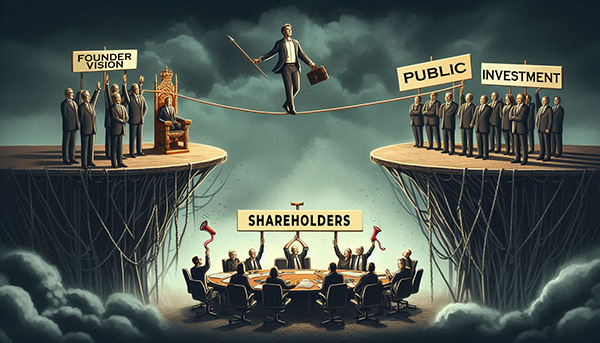
At the heart of dual-class shares is a delicate tension: the founders’ vision versus the public’s investment. Founders argue that this structure allows them to keep the long-term mission intact, free from the quarterly pressures of Wall Street, activists, or other short-term interests. They say, “Trust us, we know what we’re doing,” and sometimes, they do. Tech titans like Google and Facebook have flourished under this model, delivering groundbreaking innovations that might not have been possible without founders retaining full control. It’s a love letter to visionary leadership and entrepreneurial spirit.
But here’s the flipside: unchecked power can turn corporate governance into a dystopian sitcom, where the boardroom feels more like a monarchy than a democracy. Investors are left feeling like the audience of a play they helped finance, but they don’t get to influence the script—no matter how loudly they cheer or boo. In the worst cases, dual-class shares can lock in bad leadership, stifle accountability, and leave the company’s direction vulnerable to the whims of a few who hold all the cards.
Why does this matter? Because companies don’t exist in a vacuum. They have shareholders, employees, customers, and communities to answer to. The power dynamics created by dual-class shares may tip the scales too far in favor of insiders at the expense of everyone else. This can cause resentment, mistrust, and ultimately, a decline in the company’s value or reputation.
At their best, dual-class shares can foster innovation by protecting founders from knee-jerk reactions and giving them room to breathe. At their worst, they can isolate leadership in an echo chamber where dissenting voices are silenced, even if they have valid concerns. In either case, dual-class shares demand a level of trust—a belief that those in control won’t abuse their power or lose sight of the bigger picture. But that trust isn’t guaranteed.
The real question moving forward is whether investors will continue to accept this imbalance of power. As more companies go public with dual-class structures, pressure is building for better safeguards—like sunset clauses or caps on voting power—to ensure that this isn’t a perpetual royalty system. After all, even kings and queens eventually face a reckoning. Shareholders may push back harder in the coming years, demanding not just a voice, but a real seat at the table.
In the grand scheme of things, whether you love or hate dual-class shares, they aren’t going anywhere soon. The founders of today and tomorrow are drawn to this model like moths to a flame, enamored by the idea of steering their companies without interference. But as more investors grow tired of being passive passengers, there may come a tipping point where the structure itself is reexamined, redefined, or even reined in.
At least now you can laugh a little as you realize just how much power is held by a lucky few—and how much the rest of us are just along for the ride. Whether you’re a fan of this system or a critic, one thing is certain: dual-class shares will continue to shape the corporate landscape, often in unpredictable ways. Buckle up—it’s going to be an interesting ride.
Author: John S. Morlu II, CPA is the CEO and Chief Strategist of JS Morlu, leads a globally recognized public accounting and management consultancy firm. Under his visionary leadership, JS Morlu has become a pioneer in developing cutting-edge technologies across B2B, B2C, P2P, and B2G verticals. The firm’s groundbreaking innovations include AI-powered reconciliation software (ReckSoft.com), Uber for handymen (Fixaars.com) and advanced cloud accounting solutions (FinovatePro.com), setting new industry standards for efficiency, accuracy, and technological excellence.