
By: John S. Morlu II, CPA
In America today, the pursuit of a bachelor’s degree has become almost a rite of passage, like chasing down the last donut at an office party—it’s highly sought after, often coveted, and most people feel like they have to grab one to stay in the game. As of 2022, about 37.7% of Americans are walking around with that prized piece of paper, the diploma that shouts, “I survived four years of overpriced textbooks, all-nighters, and an ever-looming existential crisis!” For decades, this has been the golden ticket, the sacred scroll meant to open doors and unlock boundless career opportunities.
But what if that ticket has lost its shine? As the hiring landscape evolves, and employers start asking a new question—”What can you actually do?”—the once-mighty bachelor’s degree is starting to feel less like a sure thing and more like a very expensive certificate of completion. In a world where talent acquisition teams are shifting toward skill-based hiring, that four-year degree might hold about as much practical value as a degree in underwater basket weaving. (No offense to anyone who has mastered the fine art of aquatic crafting—I’m sure your baskets are impeccable, and Etsy customers will adore them.)
Now, let’s be clear: the pursuit of higher education is still a noble, even essential, endeavor for many. College can be a transformative experience. It’s where you learn to cram for exams in record time, become a master of procrastination, and hone the fine art of strategically napping during 50-minute lecture blocks. But as the job market becomes increasingly focused on what you can do rather than what you studied, it’s worth asking—has the college degree lost some of its golden luster?
This shift in hiring priorities isn’t just about practicality. It’s about survival in an economy where technology is evolving faster than your next software update, and the ability to adapt, learn new skills, and problem-solve in real-time is more valuable than ever. Employers are looking for people who can jump into a role, learn on the fly, and deliver results—regardless of whether they spent four years mastering Shakespearean sonnets or analyzing the socio-political dynamics of ancient Rome.
It’s time to take a closer look at whether the traditional college degree, once seen as the ultimate badge of accomplishment, is still the best path forward for those seeking success. Are we clinging to an outdated idea of education and career readiness? Could there be a better, faster, more efficient way to prepare for the future of work? In this exploration, we’ll dive into the ever-shifting landscape of education, skills, and hiring, offering some fun insights, hard truths, and a few good laughs along the way. Buckle up—because the race for the last donut is far from over, and the rules of the game are changing faster than ever.

Chapter 1: The Evolution of the Hiring Process: “Do You Have a Skill for That?”
Once upon a time, the job market was like a fairy tale. You could stroll into a job interview, flash your shiny new diploma, and instantly be crowned the Employee of the Month. Companies didn’t even care what your degree was in—after all, who wouldn’t hire someone with a double major in Interpretive Dance and Norse Mythology? Surely that person could handle the complexities of a corporate budget or design a strategic marketing plan, right?
Fast forward to today, and the fairy tale has taken a bit of a plot twist. Turns out, having a degree doesn’t automatically grant you the magical ability to solve real-world problems. The enchanted gates of employment are no longer just swung open by a degree alone. Now, employers are asking the question, “Do you have a skill for that?”
This shift didn’t happen overnight. It was like a slow-burning realization that degrees, while impressive, don’t necessarily teach you how to troubleshoot a faulty server or craft a killer PowerPoint presentation. For example, consider someone with a degree in medieval poetry (a truly noble pursuit). They sit in an interview for a data analyst job and are asked to make sense of a financial report. Naturally, they reference the lyrical woes of a Shakespearean sonnet while contemplating the balance sheet.
Spoiler alert: the company doesn’t care about your poetic musings.
As more and more employers started to realize this, the hiring process began to evolve. The degree, once the golden ticket, now shares the spotlight with something far more practical: skills. It’s no longer enough to know the sociocultural impact of Byzantine architecture (fascinating though it may be); today’s employers want to know if you can write code, analyze trends, or handle customer service meltdowns with the precision of a Navy SEAL on a rescue mission.
And so, we’ve entered the age of skill-based hiring. The question is no longer, “Where did you go to school?” but rather, “Can you do this job?” Welcome to the new hiring process—where your knowledge of medieval knights won’t help unless you’re applying to work at a Renaissance fair.
Chapter 2: Upskilling and Reskilling: The New Buzzwords in Town
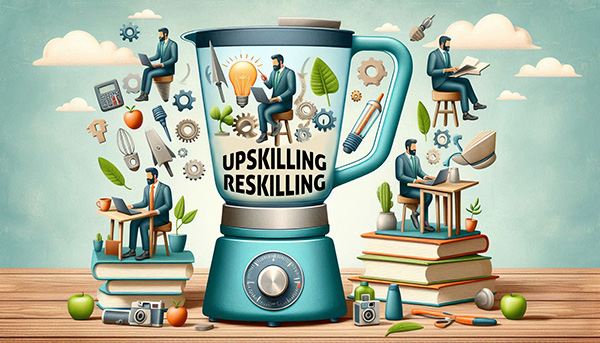
Ah, upskilling and reskilling—the latest corporate jargon to invade LinkedIn posts and HR memos. It’s like someone threw a bunch of words into a blender, added a dash of “innovation,” and poured out the perfect smoothie of modern-day career lingo. But don’t roll your eyes just yet—these terms are actually quite useful.
Let’s break them down. Upskilling is when you take what you already know and pile on more knowledge like sprinkles on a cupcake. It’s the process of making yourself even better at your current job by learning new skills. Maybe you’re already a whiz at Excel, but now you’re taking a course on data visualization because let’s face it—nobody wants to look at another boring spreadsheet. Upskilling is about keeping up with the times, ensuring that your current skills don’t become obsolete faster than your last smartphone upgrade.
Then there’s reskilling—the corporate version of starting fresh. This is when you realize you’ve hit a dead end in your current career, and you’re ready to reinvent yourself. It’s like saying, “I’ve had enough of this PowerPoint-laden existence; I want to become a pastry chef instead.” With reskilling, you dive into a completely new skill set, often jumping into an entirely different field. If upskilling is like sharpening a tool you already have, reskilling is throwing away the tool and buying a whole new set of gadgets.
Why are these terms so important now? Because in our fast-paced, tech-driven world, the half-life of skills is shrinking. Today’s cutting-edge technology could be tomorrow’s obsolete relic. Remember when knowing how to use a fax machine was considered a valuable skill? Neither do most people under 30. That’s why employers love upskilling and reskilling—they know that adaptability is key, and they want employees who can evolve with the times.
The good news? You can upskill and reskill from the comfort of your own home. Thanks to the magical world of online courses, you no longer have to go back to school for four years just to learn how to code or manage a project. You can take a boot camp, watch some YouTube tutorials, or download an app and be well on your way to becoming the company’s new data science guru. All without having to endure a single lecture on 17th-century French embroidery.
Chapter 3: Fun Fact: Your Degree May Be Useless (But Your Skills Aren’t!)
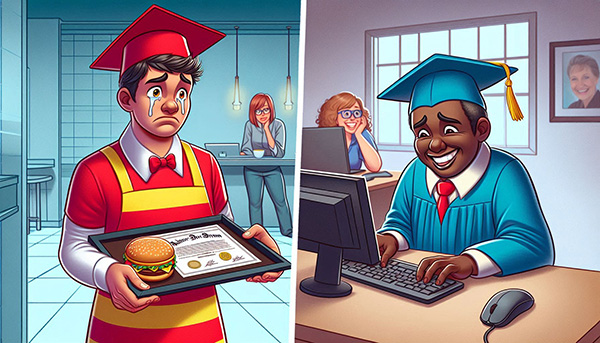
Here’s a fact that will make you either laugh or cry (depending on how much you owe in student loans): about 41% of recent college graduates are underemployed. That means almost half of them are working jobs that don’t require their degree. So, all that time spent studying for exams and pulling all-nighters to write a thesis on “The Symbolism of Water in Modern Literature” might not have been the best investment after all.
Imagine this: you just graduated with a degree in Environmental Science, ready to save the planet one recycled bottle at a time. You’re idealistic, passionate, and…working at a fast-food restaurant because the job market is rough. As you hand out fries to disgruntled customers, you wonder, “What happened to my dreams of eco-activism?”
But fear not—this is where skill-based hiring comes to the rescue. The good news is that while your degree might be gathering dust, your skills are still incredibly valuable. Maybe you don’t need a degree to analyze data, manage social media, or write brilliant copy for a startup. Maybe, just maybe, those four years of college were more about networking, critical thinking, and learning how to live off ramen noodles than they were about preparing you for the actual job market.
This realization is sparking a revolution in the hiring process. Employers are finally starting to understand that a degree doesn’t always mean you’re ready for the workforce. Just because you can recite all of Aristotle’s “Nicomachean Ethics” doesn’t mean you can manage a CRM system or troubleshoot a website issue.
In short, skills trump degrees in today’s job market. So, if you’re feeling down about your unused diploma, remember that you can still reskill, upskill, and pivot into a career that actually makes use of what you’re good at—like analyzing numbers, writing code, or fixing broken printers.
Chapter 4: The Myth of the Soft Skills vs. Hard Skills Debate
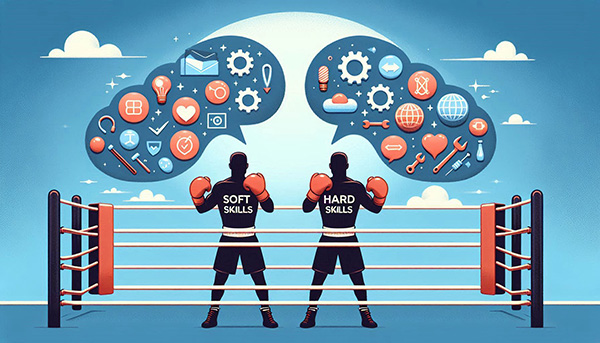
For years, hiring managers have been obsessed with the balance between soft skills and hard skills. Soft skills are things like communication, teamwork, and leadership—the kinds of traits that make you a pleasure to work with in an office setting (or at least, someone who doesn’t cause daily HR complaints). Hard skills, on the other hand, are the technical abilities you need to actually do the job—like coding, accounting, or operating heavy machinery without accidentally driving it into a wall.
There’s always been this myth that soft skills and hard skills are in a battle for dominance, like two heavyweight boxers fighting for the hiring manager’s attention. But here’s the truth: you need both. You could be the world’s best coder, but if you can’t communicate your ideas to your team without breaking into a cold sweat, your hard skills aren’t going to get you very far. On the flip side, you could be a fantastic communicator, but if your boss asks you to fix a server crash and you respond with a motivational speech, you’re probably not going to make it past your probation period.
In today’s job market, the real winners are the people who can juggle both. If you can charm your way through an office presentation and then turn around and debug a software issue, you’ve essentially achieved workplace nirvana. You’re the unicorn that employers are desperately searching for, and if you play your cards right, you might even get that elusive corner office.

Chapter 5: The Battle of College vs. Boot Camps
Picture this: two contenders enter the ring. In one corner, we have the traditional four-year college degree—it’s well-established, expensive, and has a reputation for making people cry over midterms. In the other corner, we have the skill-based boot camp—lean, mean, and promising to teach you everything you need to know in six months or less. Who will win?
Let’s start with the college degree. Sure, it’s prestigious, but it also comes with a hefty price tag and a curriculum that may or may not be relevant to the job you actually want. Four years of studying philosophy might make you a hit at dinner parties, but it’s not going to help you when your boss needs a marketing strategy by the end of the day. Plus, with student loans that stretch into infinity, you might be paying off that degree long after your enthusiasm for existential musings has faded.
On the other hand, boot camps are like the fast-food version of education: quick, practical, and designed to get you hired. Instead of spending four years learning about ancient Greek philosophers, you could spend six months learning how to code, design websites, or manage digital marketing campaigns. It’s like skipping the formal dining experience and heading straight for the food truck—you get exactly what you need, without the frills (or the debt).
And the best part? Boot camps are focused on skills—the exact skills that employers are desperate for. You’re not wasting time on general education classes; instead, you’re learning hands-on, real-world applications that you can immediately use in the job market.
Author: John S. Morlu II, CPA is the CEO and Chief Strategist of JS Morlu, leads a globally recognized public accounting and management consultancy firm. Under his visionary leadership, JS Morlu has become a pioneer in developing cutting-edge technologies across B2B, B2C, P2P, and B2G verticals. The firm’s groundbreaking innovations include AI-powered reconciliation software (ReckSoft.com) and advanced cloud accounting solutions (FinovatePro.com), setting new industry standards for efficiency, accuracy, and technological excellence.