
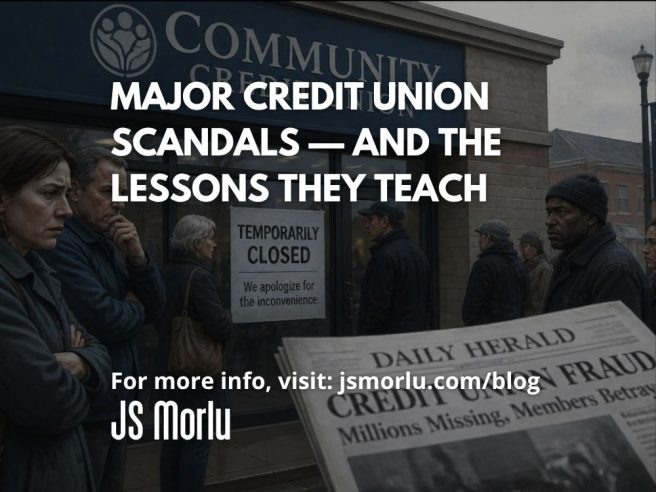
Credit unions are built on trust. They’re the hometown alternative to big banks — member-owned, community-focused, and proudly different.
But when scandals hit, they cut deeper. Because members aren’t just customers — they’re owners. And betrayal feels personal. A scandal at a credit union isn’t just a financial event. It’s a community event. It damages relationships that took decades to build and can shatter the cooperative model that makes credit unions worth choosing in the first place.
Fun Fact #1: The Biggest Credit Union Fraud in U.S. History Was Committed by a CEO
In 2018, the NCUA took over CBS Employees Federal Credit Union in California after discovering that its CEO, Edward Rostohar, had stolen over $40 million over two decades.
How? Simple, old-school fraud:
- Writing checks to himself.
- Manipulating records.
- Exploiting weak internal controls.
He was the only person reviewing certain transactions — a textbook segregation of duties failure. For twenty years, no independent set of eyes caught what was hiding in plain sight.
Lesson: Even long-serving, well-liked executives can be your biggest risk if controls aren’t airtight. Tenure and likability are not substitutes for oversight.

Case Study: The Small Credit Union That Lost Big
In 2010, St. Paul Croatian Federal Credit Union in Ohio collapsed after its CEO, Anthony Raguz, approved more than 1,000 fraudulent loans totaling $70 million — often to friends and associates. The loans were rubber-stamped with little to no documentation.
The NCUA had to cover the losses through the National Credit Union Share Insurance Fund (NCUSIF), costing other credit unions across the country. Innocent members of completely unrelated institutions paid the price for one organization’s failure to govern itself.
Lesson: Loan fraud doesn’t just hurt one credit union — it can ripple across the entire system. And the reputational damage extends far beyond the institution that failed.
Fun Fact #2: Many Scandals Start Small
The ACFE reports that most fraud begins with small “testing” transactions. If no one notices, the amounts grow until the scheme becomes massive — or collapses under its own weight. The fraudster isn’t bold from the beginning. They become bolder each time a transaction goes unchallenged.
This is why early detection matters so much. A robust monitoring program that flags unusual transactions — even small ones — stops fraud at $5,000 rather than $5 million.
Patterns We See in Credit Union Scandals
- Weak Internal Controls: One person controls too much of the process.
- Poor Board Oversight: Directors trust management without verification.
- Inadequate External Audits: Rubber-stamp audits that don’t dig deep.
- Failure to Respond to Red Flags: Complaints or anomalies ignored.
These patterns appear in nearly every major credit union scandal. They’re not random. They’re structural — the result of governance gaps that were present long before any fraud occurred. The fraud is almost always the symptom. The failed system is the disease.

CPA Insight: Fraud Prevention Is Cheaper Than Fraud Recovery
Recovering stolen funds is rare — most of the money is gone before discovery. Prosecutions take years. Reputations don’t recover while cases wind through courts. The best ROI comes from prevention:
- Segregation of duties.
- Surprise audits.
- Transaction monitoring.
- Fraud hotlines for employees and members.
Each of these tools costs a fraction of what a single fraud incident costs to investigate, litigate, and recover from. Prevention isn’t just the right strategy — it’s the only economically rational one.
The Member Trust Factor
A scandal doesn’t just cost money — it costs decades of brand equity. Once members start asking, “If they missed that, what else are they missing?” the damage is done. Accounts close. Referrals stop. The community advantage that makes credit unions competitive evaporates.
And unlike banks, credit unions can’t offset reputational losses with massive marketing budgets. Their competitive advantage is trust itself. When that’s gone, there’s nothing left to compete on.
Fun Fact #3: Fraudsters Count on Being “Too Trusted to Check”
Long tenure, friendly personality, and perceived loyalty are the perfect camouflage for misconduct. The most dangerous fraudsters in credit union history weren’t outsiders or hackers — they were insiders who had earned enough trust to operate without scrutiny.
The best defense? Audit everyone — without exception. Not as a sign of distrust, but as a sign of good governance. The people who have nothing to hide are not bothered by verification. The ones who are bothered by it are the ones you need to be verifying.
The Strategic View
Credit union scandals are preventable when boards, management, and auditors work together to demand transparency, verify independently, and act quickly on red flags. This isn’t about paranoia — it’s about building the kind of institution that members can trust for decades.
Our Role in Scandal-Proofing Credit Unions
We help credit unions:
- Conduct independent fraud risk assessments.
- Strengthen governance and oversight.
- Implement audit programs that uncover what others miss.
Call to Action
📌 Don’t wait for headlines. With CPA-led risk assessments and internal control reviews, your credit union can protect members, prevent loss, and keep your reputation spotless.