
By: John S. Morlu II, CPA
A Strange and Beautiful Word
There is a strange and beautiful word in the human language: touché.
It is only one word. Two syllables. No shouting. No drama. No long speech. Just… touché. And yet, this tiny word has ended more arguments than shouting ever could.
It is the verbal version of someone gently placing a crown on your head and saying, “You got me.” No excuses. No excuses dressed up as explanations. No emotional gymnastics. Just quiet surrender. And that is why most people secretly hate it—because touché requires something rare: ego humility.

The Lost Art of Losing Gracefully
Most people do not know how to lose. They know how to argue. They know how to deflect. They know how to blame childhood, Mercury retrograde, the economy, their boss, their ex, the government, or their dog.
But losing gracefully? That skill went extinct around the same time as dial-up internet.
If you correct someone, watch what happens. You will see a live theater performance:
- The Defensive Speech
- The Emotional Counterattack
- The Sudden Topic Change
- The Ancient History Excavation
- The “You Always Do This” Documentary
Anything except the one word that would end the entire situation peacefully: touché.
Machiavelli Would Smile
If Machiavelli were alive today, he would quietly whisper: “The strongest person in the room is the one who does not need to win every moment.”
Power is not yelling louder. Power is not winning every argument. Power is not dominating conversations like a loudspeaker in a library. Real power is control.
And the person who can calmly say touché shows terrifying levels of control. Because they are not protecting their ego—they are protecting their long-term reputation. And reputation compounds like interest.
Carl Jung and the Ego Gym
Carl Jung believed we all have a shadow—the part of ourselves we don’t want to admit exists. One of the shadow’s favorite hobbies is being wrong while insisting it is right.
Your shadow hates the word touché. It whispers things like:
- “You can’t admit that.”
- “You’ll look weak.”
- “Fight back.”
- “Say something clever.”
But Jung would say something uncomfortable: the moment you can calmly say touché is the moment you become more whole. Because the ego shrinks, and the self grows. And growth hurts the ego like leg day hurts the thighs.
Nietzsche and the Fragile Ego Olympics
Nietzsche once warned about fragile pride disguised as strength. Today, we see it everywhere.
People would rather:
- lose friendships,
- destroy partnerships,
- ruin opportunities,
- and burn bridges
than admit a small mistake. It is like refusing to admit you took the wrong exit… while driving into the ocean. Touché could save the car. But pride says, “Keep driving.”
The Corporate Meeting Version of This
Picture a meeting. Someone presents a bad idea. Another person politely points out the flaw. Now we wait.
Will we get Option A: “Ah, good catch. Touché.” Or… Option B: a 12-minute PowerPoint presentation titled “Why This Was Actually Not My Fault.”
Most workplaces choose Option B. Then they wonder why projects fail.
Seneca and the Peace Shortcut
The Stoics loved simplicity. Seneca would probably say: “Why carry the heavy backpack of defensiveness when one word drops the weight?”
Touché is emotional minimalism. It ends tension instantly. It saves time. It saves energy. It saves relationships.
It is the emotional equivalent of turning off a smoke alarm instead of arguing with it.

Freud and the Defense Mechanism Factory
Sigmund Freud spent his career studying how humans avoid discomfort. He gave names to our favorite escape tricks:
- denial
- projection
- rationalization
- displacement
Basically, Freud created a dictionary for the phrase: “I refuse to say touché.”
Because that one word shuts down the entire defense mechanism factory. And factories hate shutdowns.
Dostoevsky and the Drama Addiction
Fyodor Dostoevsky understood something deeply human: people sometimes prefer suffering over simplicity.
We will choose a dramatic argument over a peaceful resolution. We will write emotional novels in real life when a single sentence would end the story.
Touché is the shortest novel ever written. One word. Conflict resolved. Too simple for our drama-loving brains.
Kafka and the Courtroom of Ego
Franz Kafka would probably imagine a courtroom where people are on trial for being wrong. The trial never ends. The evidence keeps growing. The verdict never arrives.
Why? Because the defendant refuses to say touché. And so the trial continues forever.
Some arguments last years… simply because nobody used one word.
The Real Strength Test
Here is the truth nobody likes: the ability to say touché is a sign of confidence, not weakness.
Weak people must win every moment. Strong people win the long game. Weak people protect pride. Strong people protect progress. Weak people fight every battle. Strong people choose which wars matter.
Marcus Aurelius would quietly remind us: “You don’t have to attend every argument you’re invited to.” And sometimes, the most powerful move is simply: touché.
The Quiet Superpower
Imagine a world where more people used this word. Meetings would end faster. Arguments would shrink. Relationships would last longer.
Twitter would collapse overnight. Chaos would decrease by 47%. Okay, maybe 46%. But still.
Final Thought
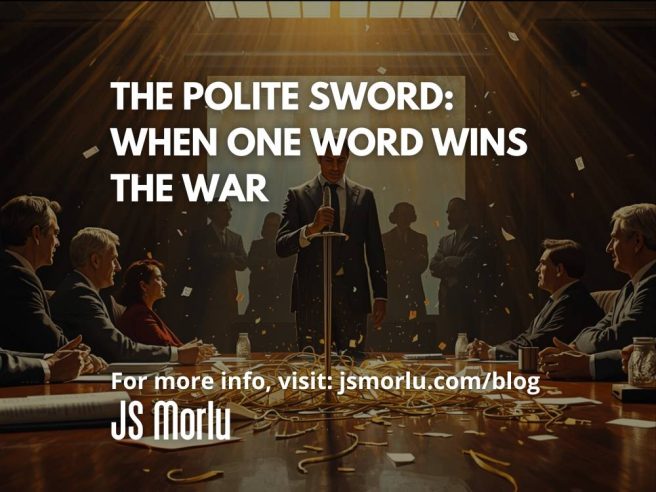
The next time someone makes a good point, resist the urge to defend your ego like a medieval castle. Try the polite sword instead.
One word. Two syllables. Infinite maturity. Touché. And just like that, the war ends.
Author: John S. Morlu II, CPA is the CEO and Chief Strategist of JS Morlu, leads a licensed public accounting and management consultancy firm. He has more than 20 years of professional experience in auditing and advisory work, including service as Auditor General of Liberia and FAR and DCAA compliance work at Unisys Federal Systems. The firm’s technology products include AI-powered reconciliation software (ReckSoft.com), a handyman services platform (Fixaars.com) and advanced cloud accounting solutions (FinovatePro.com), built for finance and operations teams.