
By: John S. Morlu II, CPA
Every country has its economic engine. Nigeria has oil. Ghana has gold. Kenya has ambition. Benin has peace—and it’s quietly turning that peace into property value.
While other capitals rise and fall on political drama and speculative hype, Cotonou’s skyline grows with the same personality as the nation itself: steady, composed, and quietly profitable. Welcome to Benin’s real estate boom—where the returns are modest, the paperwork is clean, and the biggest driver of appreciation isn’t speculation, but stability.

1. The Value of Predictability
Investors like numbers. But what they love even more is sleep—and Benin offers both.
The country’s macroeconomic stability—low inflation, a disciplined fiscal regime, and a trustworthy central banking framework under the BCEAO—has turned it into one of West Africa’s most stable property markets.
In a region where “title deed” sometimes translates to “hope and prayer,” Benin quietly reformed its land registration system, digitalized urban planning approvals, and simplified property taxes. You don’t need political connections to own land—just paperwork, patience, and decency. That alone adds real confidence to the market.
2. Cotonou: The Capital of Calm Returns
The heart of Benin’s real estate story beats in Cotonou—the coastal capital that behaves like an accountant and dreams like an architect.
Modern apartment blocks are rising along Fidjrossè, Haie Vive, and Les Cocotiers—areas where infrastructure meets lifestyle. Developers are targeting a new wave of buyers: middle-class professionals, diaspora investors, and entrepreneurs seeking both returns and refuge.
The formula is simple:
- Political stability
- Good roads
- Constant electricity
- Safety at night
Together, they create compounding confidence. A Lagos investor put it perfectly: “I came to rest—and then I bought land.”
3. The Diaspora Dividend
Benin’s real estate boom is being powered by its diaspora class—professionals from France, the U.S., and neighboring countries returning home with capital and a taste for structure.
Unlike speculative buyers elsewhere, these investors are builders, not flippers. They care about long-term rental yields, architectural quality, and regulatory peace of mind.
Diaspora money doesn’t chase quick returns; it builds neighborhoods. And Benin—with its stable democracy and clean governance reputation—gives them the confidence to plant roots, not just wire funds.
4. The Port Effect: Logistics Meets Lifestyle
Few people realize it, but Cotonou’s port modernization is quietly driving residential demand.
As the country’s logistics and trade sector grows, so does the need for housing near industrial zones, customs corridors, and the new transport hubs connecting Benin to Niger and Burkina Faso.
Engineers, managers, and consultants are fueling steady rental demand, especially for serviced apartments and mid-tier homes. Benin’s secret is not explosive growth—it’s nonstop functionality. When a country’s ports run on schedule, so do its mortgages.
5. Tourism and the “Weekend Economy”
Cotonou, Ouidah, and Grand-Popo are developing a new asset class: the lifestyle weekend economy.
Small resorts, Airbnb-style villas, and boutique hotels are multiplying, serving both tourists and urban professionals escaping city stress.
Investors who once looked at real estate only for long-term rentals now see opportunity in short-term serenity. A well-designed beachfront apartment can generate more passive income than a noisy club in Lagos—because Benin’s secret advantage is not scale; it’s sanity.
6. The Cost of Peace (and Why It’s Profitable)
Benin’s calmness isn’t just cultural; it’s an economic differentiator.
Stable politics mean stable property valuations. Low crime means lower insurance costs. Decent governance means developers don’t have to bribe their way through a construction schedule.
The result is a real estate market where risk premiums are shrinking while rental yields hold steady between 6% and 10% annually in urban areas. In finance, that’s called boring alpha. In Benin, it’s called normal life.
7. Modesty as Market Logic
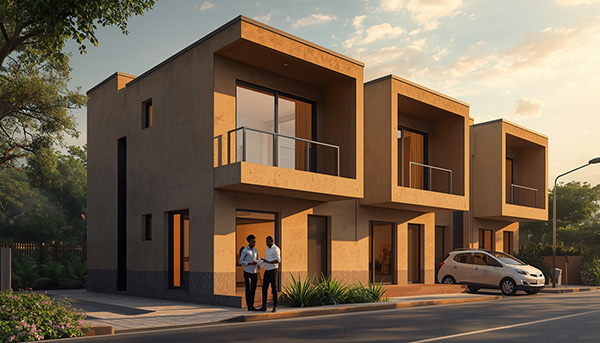
Benin’s housing boom isn’t built on ego towers or speculative illusions. It’s built on practical elegance.
- Apartments are functional, well-lit, and energy-efficient.
- Architects prioritize airflow over marble.
- Developers talk sustainability more than skyscrapers.
Benin builds what it can maintain—and that humility pays off. As one architect said: “We’re not racing Dubai. We’re designing dignity.”
8. Institutional Trust: The Real Foundation
The rise of Benin’s real estate market also reflects something deeper: the credibility of its institutions.
The Ministry of Urbanism and Housing has cleaned up land titles, introduced zoning reforms, and strengthened environmental regulations. The Ministry of Finance tracks property taxes transparently.
And the banking sector, regulated by the BCEAO, offers structured mortgages and diaspora-friendly products with predictable interest rates. In West Africa, that’s not common. In Benin, it’s Tuesday.
9. The Gambia and Togo Are Watching
Regional investors are quietly benchmarking Benin’s housing model—small, stable, and service-oriented.
Cotonou’s clean governance and efficient port logistics have made it a preferred base for cross-border professionals.
Gambian and Togolese developers are already exploring joint ventures, looking to replicate Benin’s blend of peace, paperwork, and predictability.
10. The Humor Premium
Even in real estate, Beninese humor slips in.
Ask a local about land speculation, and you’ll hear: “In Benin, we don’t buy land to brag. We buy it so our children can sleep well.”
That’s the real difference: land here isn’t just an asset—it’s inheritance with integrity. In an economy that treats peace as infrastructure, ownership feels less like conquest and more like continuity.
11. The Investor’s Translation
If you’re considering buying property in Benin, understand this cultural math:
| Concept | In Benin Means |
|---|---|
| “Patience” | Fast progress without panic |
| “Guarantee” | Paperwork and peace of mind |
| “Luxury” | Comfort without chaos |
| “Growth” | Stability that compounds |
| “Exit strategy” | Legacy planning |
In Benin, even real estate has manners.
12. Final Reflection — The Dividend of Discipline
Benin’s real estate boom is not fueled by hype or hashtags. It’s powered by governance, grace, and gradualism—the same ingredients that make the nation itself so investable.
You won’t find aggressive speculation or dramatic price swings. You’ll find predictability, respect, and quiet growth—the kind that compounds when no one’s looking.
Because in Benin, the most valuable real estate isn’t just land. It’s trust. And as global investors are beginning to discover, that’s the only asset class that never loses value.
Author: John S. Morlu II, CPA is the CEO and Chief Strategist of JS Morlu, leads a licensed public accounting and management consultancy firm. He has more than 20 years of professional experience in auditing and advisory work, including service as Auditor General of Liberia and FAR and DCAA compliance work at Unisys Federal Systems. The firm’s technology products include AI-powered reconciliation software (ReckSoft.com), a handyman services platform (Fixaars.com) and advanced cloud accounting solutions (FinovatePro.com), built for finance and operations teams.