
By: John S. Morlu II, CPA
There are cities you visit. And then there are cities that visit you.
Ouidah, Benin, belongs to the second kind—the kind that doesn’t just welcome you; it studies you. It feels like history watching back.
Every street here is a conversation between centuries. Every breeze carries a rumor—of gods, of traders, of tears that never dried. And if you stand quietly at the shoreline long enough, you can almost hear the Atlantic whispering its apology.
1. The Port of No Return — and the Courage to Remember
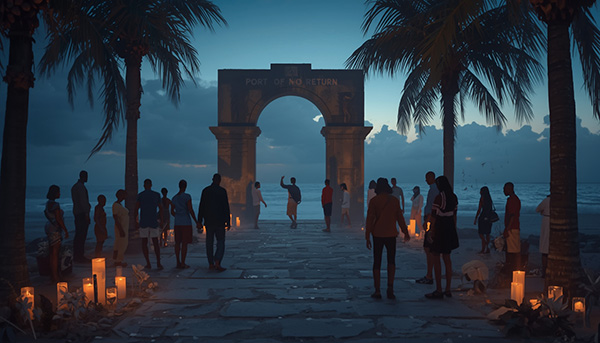
Ouidah was once the final African footprint for millions taken across the Atlantic during the slave trade. Its “Route des Esclaves”—the Slave Route—leads to the Port of No Return, a haunting monument facing the ocean. It is both memorial and mirror. Every visitor feels it differently: grief, guilt, awe, silence.
But Ouidah refuses to be only a story of sorrow. It is also a story of survival.
The same land that witnessed humanity’s worst is now a sanctuary of faith, art, and renewal. Here, pain evolved into philosophy. The city turned trauma into ritual, and ritual into resilience.
2. The City Where the Gods Still Take Attendance
Ouidah is the spiritual headquarters of Vodun (Voodoo)—not the movie version with dolls and pins, but the real, ancient, cosmic order that believes everything—water, fire, stone, word—is alive.
The temples here are not tourist decorations. They are living negotiations between humans and the universe.
At the Temple of Pythons, sacred serpents roam like dignitaries, slithering through myth and modernity. Locals say, “If you fear the python, you fear balance.” In Ouidah, even fear is philosophical.
Every January 10, the city hosts the International Vodun Festival—a day when priests, artists, and wanderers gather in one rhythmic declaration: “We are still here.” It is one of the most remarkable cultural events in Africa—equal parts spiritual summit and cultural carnival.
And yes, the Atlantic watches quietly—perhaps remembering its own sins.
3. The Architecture of Contradiction
Ouidah’s skyline tells a layered story:
- Portuguese forts that once organized trade in sorrow.
- Afro-Brazilian mansions built by returnees who brought back architecture and faith from Bahia and Salvador.
- Bright colonial facades standing beside clay shrines and murals of gods.
This is a city that forgave without forgetting. Its beauty lies in its contradictions—Catholic crosses beside Vodun symbols, Latin hymns echoing over drumbeats. No one seems offended by the overlap. Here, spirituality doesn’t compete—it coexists.
4. Where the Atlantic Is Afraid to Be Loud
Walk to the beach at dusk, and you’ll notice something strange. The waves don’t crash as violently here. They seem… careful.
Locals joke that even the ocean knows better than to make noise near a sacred memory. Children play football. Vendors sell grilled fish and laughter. But beneath it all, the air hums with quiet power—as if the ancestors are politely supervising.
It’s peace with depth—not the silence of absence, but of presence.
5. The Returnees and the Art of Reconciliation
Ouidah is also a city of return—of Afro-descendants from Brazil, Haiti, Cuba, and the Caribbean who came back in search of belonging. They built churches, schools, and communities. They brought rhythm, architecture, and surnames that sound like poetry—da Silva, de Souza, Araujo. Their presence turned the city into an Afro-Atlantic archive—a living museum of reunion.
Every returnee story begins with pain and ends with purpose. And somehow, Ouidah makes that emotional math work.
6. Where History Became a Business School
There’s an odd but profound lesson in Ouidah’s resilience: this city proves that economies built on memory can also fund the future.
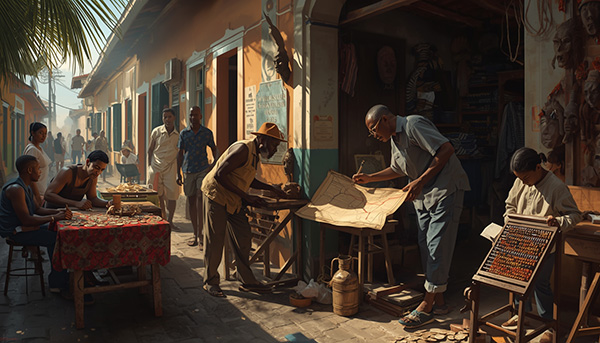
Heritage tourism thrives here—but tastefully. Artists, local guides, and spiritual custodians all earn livelihoods while preserving dignity. No one exploits pain for profit; they curate it into wisdom.
The result is a sustainable cultural economy powered by reflection. Ouidah teaches that remembering well can also pay well.
7. Humor, Humanity, and the Local Code of Sincerity
Despite its heavy history, Ouidah isn’t melancholic—it’s weirdly joyful. The people laugh often, joke easily, and live slowly. They sell souvenirs with the same seriousness as philosophy. You’ll hear someone at a café say, “The spirits have Wi-Fi here—they always find you.”
Even in their humor, there’s respect. Beninese wit doesn’t mock the sacred; it dances with it.
And maybe that’s what makes this place unforgettable: Ouidah has made peace with its ghosts, so it can host the living.
8. Lessons for a World Forgetting Its Soul
Ouidah’s biggest export today isn’t palm oil or textiles—it’s perspective. In an age obsessed with technology, productivity, and performance, this small city stands as a quiet warning and a tender reminder.
It whispers to every visitor:
- “Progress without memory is amnesia with a budget.”
- “Innovation without roots is just noise in new packaging.”
Ouidah doesn’t want your pity or praise. It wants your awareness.
9. The Future Is Remembering
Today, Benin’s government invests in preserving Ouidah’s heritage, restoring monuments, improving access roads, and promoting cultural tourism. But the true renovation happens in the soul of every visitor who walks its sacred route.
Because Ouidah doesn’t just tell you what happened. It asks who you are—and what you’ll do with what you now know.
You arrive as a tourist. You leave as a witness.
10. Final Thought
Ouidah is not merely a city. It’s a conscience carved in stone and salt. It’s the Atlantic’s apology turned into art. It’s Africa looking itself in the mirror—and smiling again.
And if you listen closely enough, the wind will tell you the truth: The past is not behind us. In Ouidah, it walks beside us—calmly, wisely, and forever unafraid.
Author: John S. Morlu II, CPA is the CEO and Chief Strategist of JS Morlu, leads a licensed public accounting and management consultancy firm. He has more than 20 years of professional experience in auditing and advisory work, including service as Auditor General of Liberia and FAR and DCAA compliance work at Unisys Federal Systems. The firm’s technology products include AI-powered reconciliation software (ReckSoft.com), a handyman services platform (Fixaars.com) and advanced cloud accounting solutions (FinovatePro.com), built for finance and operations teams.