
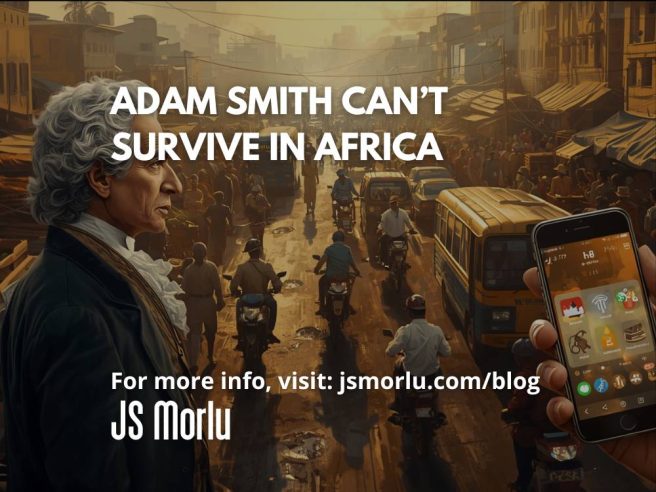
Why Western Economics Must Be Rewritten Before It Lands on This Continent
By: John S. Morlu II, CPA
Let’s be brutally honest from the start: Adam Smith would not last three days in Africa before writing a resignation letter to Scotland. Not with that “invisible hand” theology he preached.
Here, the invisible hand needs to carry cash, know somebody’s uncle, dodge potholes, negotiate fiercely, speak three languages, and understand market psychology at a spiritual level.
Africa does not operate on The Wealth of Nations. Africa operates on The Hustle of Nations—fueled by improvisation, prayer, luck, networking, emotional pricing, and the ever-present “something small for the boys.”
Let’s explore this continent where economic theories come to die, resurrect, reinvent themselves, and come out as Afrobeat remixes.
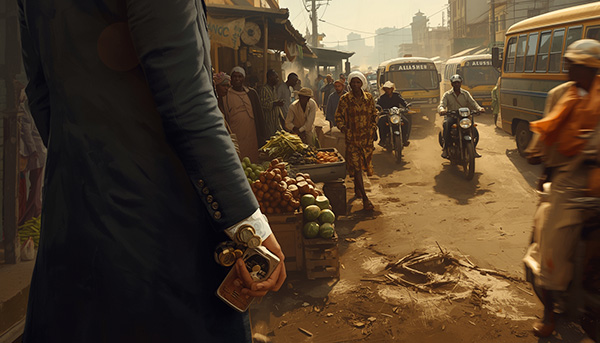
1. The Invisible Hand Must Carry Cash — and Be Street Smart
Adam Smith’s invisible hand gently nudges markets. Here in Africa, the invisible hand must:
- Hold cash
- Hold change (never guaranteed)
- Hold patience
- Hold your phone tightly
- Hold your temper
- And sometimes hold your slippers while you run
Drop Adam Smith in Lagos traffic and he will start questioning capitalism, philosophy, and his own existence.
Drop him in Accra’s Makola Market, and he’ll rewrite The Wealth of Nations as The Wealth of Negotiations.
Drop him in Nairobi’s River Road, and he’ll need three bodyguards and a prayer warrior.
Market self-regulation? Bro, even the invisible hand will beg for half-day leave.
2. Price Mechanism? Cute. We Have Emotional Pricing.
Western textbooks: Price = Supply + Demand.
African reality: Price = Who You Are + How You Look + Who You Know + Vibes + Weather + Seller’s Mood + School Fees Crisis + Electricity Situation + Your Accent.
Price is not a number here. Price is a conversation.
Try buying anything:
- Foreigner? Add 40%.
- American accent? Add 30%.
- Nigerian accent? Respect + discount + suspicion.
- Looking too confident? Emotional surcharge.
- Trying to walk away? Discount 25%.
- Returning after walking away? Price triples.
- Wearing a suit? You are now officially the financial sponsor of someone’s weekend.
Adam Smith didn’t account for:
- Ego
- Vibes
- Emotional instability
- Heatwave surcharge
- December price insanity
- “Dollar rate” excuse even when the product is local
No wonder he won’t survive here.
3. Perfect Competition? We Have Perfect Confusion.
Western economics assumes:
- Many sellers
- Many buyers
- Perfect information
- No deception
- Identical products
Africa heard that and said: “Cute theory. Not applicable.”
In African markets:
- Every tomato seller insists hers is “fresh from the farm,” even though you saw the same basket at five different stalls.
- Mechanics confidently swear the last mechanic “spoiled everything.”
- Barbers, tailors, and plumbers all believe God called them into the profession.
- Every pricing conversation starts with, “My sister, things are hard.”
Perfect information? Even Google Maps gives up sometimes and says: “Rerouting… rerouting… may God help you.”
Western models cannot describe this. Only African aunties can—and with more accuracy.
4. The “Rational Economic Actor”? No. Africa Has the “Survivalist Gymnast.”
Western theory: People make rational decisions. African reality: People make creative, emotional, and culturally compliant decisions, sometimes supervised by ancestors.
Examples:
- Someone will refuse insurance because “God will protect me,” but buy an iPhone 15 on credit because “life must balance.”
- Someone will skip tax but contribute $300 to a funeral because “what will people say?”
- Someone will decline a job but buy expensive aso-ebi for a wedding that adds zero value.
Rationality is optional. Reputation is mandatory.
Adam Smith never calculated “what people will say” in his models. That’s why he must not come here without training.
5. Opportunity Cost? Africa Invented It — Then Added Emotional Tax.
Western definition: Opportunity cost is what you give up to get something else.
African definition: Opportunity cost is choosing between:
- Paying rent
- Paying school fees
- Paying generator fuel
- Buying food
- Supporting someone’s GoFundMe
- Or pretending your phone is off
Plus, there’s the hidden emotional opportunity cost:
Say “no” to a relative and you pay in guilt for ten years. Say “no” to a village project and you are spiritually audited. Say “no” to lending someone money and suddenly you become “proud.”
Adam Smith didn’t prepare for extended-family liabilities.

6. Free Market? Please. Free Market Where?
The concept of a free market sounds amazing—until you meet:
- A cousin controlling supply
- A neighbor controlling distribution
- An uncle controlling sector approvals
- Government controlling the weather through press releases
- The local chief controlling land
- Inflation controlling your sanity
The only truly free market? WhatsApp groups, where people are selling:
- Dogs
- Cars
- Sofas
- Land
- Wedding cakes
- Miracle oils
- And occasionally, divine prophecy
—all in one chat. Try regulating that.
7. Scarcity? Africa Has Scarcity of Scarcity.
Western economists panic over scarcity. Africa lives in scarcity like it’s a roommate.
We have scarcity of:
- Fuel
- Water
- Trust
- Light
- Job opportunities
- Stable internet
- And sometimes logic
Yet life continues with an unexplainable grace:
- Weddings still happen with 600 guests
- People still dress like royalty
- Restaurants still full
- Football matches still watched
- New babies still born
- Street vendors still smiling
- And the continent keeps moving with quiet, stubborn resilience
Scarcity here is not an economic concept—it is a spiritual workout.
8. GDP Growth vs Real Life — The Ultimate African Paradox
Western economists love GDP growth. African governments love announcing it.
But citizens look around like: “Where is the growth? Show us the part that grew.”
Because in Africa:
- GDP grows
- Inflation grows
- Unemployment grows
- Poverty grows
- Corruption grows
- Roads grow potholes
Everything grows except the bank account of the average citizen.
Adam Smith did not prepare for the African version of growth—where everything grows except prosperity.
9. Supply Chain Theory vs African Logistics
Western supply chain: Producer → wholesaler → retailer → consumer.
African supply chain: Producer → cousin → driver → another cousin → agent → friend → middleman → the driver’s girlfriend → shopkeeper → you.
By the time it reaches you, the price includes:
- Fuel scarcity
- Emotional stress
- National inflation index
- The middleman’s dream to relocate abroad
- Two phone calls
- A fight
- The weather
- 10% “just because”
Adam Smith will stop believing in capitalism.
10. Fun Fact: Africa Has the World’s Greatest Economists — Without Degrees
Meet the economic geniuses:
- Market women: They have dynamic pricing, data analytics, psychology, and inventory management all in one head.
- Taxi drivers: They can predict inflation, political instability, and economic downturn with scary accuracy.
- Mechanics: They do instant cost-benefit analysis.
- Betting experts: Behavioral economics PhDs in disguise.
Africa is a daily MBA program—and nobody graduates.
11. The Real Truth: Western Economics Is Too Clean for Africa
Africa is not messy—Africa is creatively organized chaos. Each day is a PhD-level case study.
Western economics tries to describe a world of:
- Predictability
- Order
- Logic
- Stable institutions
Africa operates on:
- Flexibility
- Improvisation
- Spiritual backup
- Who-you-know energy
- Negotiation
- Emotional intelligence
- Extended-family tax policy
- Survival instinct
Africa is too multidimensional for linear economic models.
Conclusion — Rewrite the Textbooks Before We Rewrite You
Africa doesn’t need Adam Smith’s theories imported directly. Africa needs: “The Economics of Hustle, Vibes, Networking, Extended Family, Emotional Blackmail, and Generator Maintenance.”
A new textbook that includes:
- Scarcity of electricity
- “Dollar rate” excuses
- Weather-based pricing
- Wedding economics
- Funeral economics
- Tribal economics
- Market aunties’ pricing algorithm
- Political season inflation
- December premium prices
- Village tax
- Emotional opportunity cost
- And spiritual intervention variables
Until Western economics accounts for the African experience, Adam Smith should not travel here without travel insurance, courage, and a local guide.
Author: John S. Morlu II, CPA is the CEO and Chief Strategist of JS Morlu, leads a licensed public accounting and management consultancy firm. He has more than 20 years of professional experience in auditing and advisory work, including service as Auditor General of Liberia and FAR and DCAA compliance work at Unisys Federal Systems. The firm’s technology products include AI-powered reconciliation software (ReckSoft.com), a handyman services platform (Fixaars.com) and advanced cloud accounting solutions (FinovatePro.com), built for finance and operations teams.