
By: John S. Morlu II, CPA
Welcome to Ghana — where electricity is a promise, not a guarantee, and water is something you chase like rent in December.
The Power Situation (Or Lack Thereof)
Let’s talk about electricity — or as Ghanaians know it, dumsor, a word so famous it might as well have its own passport and national ID.
Now, don’t get it twisted — this isn’t your regular “oops, a fuse blew.” No, no. Dumsor is a whole personality. It doesn’t knock. It doesn’t call. It just shows up — uninvited — like that one uncle who always comes during mealtime and never leaves.
Here’s how it works:
- You’re watching a World Cup match — and just as Ghana is about to score…💥Click. Darkness.
- You finally decide to iron your church clothes after 2 weeks of procrastination —💥Click. Darkness.
- Your phone’s on 1% and you plug it in like your life depends on it —💥Boom. Try again next week.
It’s a dance. A relationship. A test of faith.
Fun Fact: Ghanaians have developed a sixth sense stronger than any Marvel superhero. They can sense when the power might go off. A slight flicker of the light bulb? That’s your 5-minute warning. A humming sound from the fridge? Better finish cooking that rice now.
And the mood? No one even panics anymore. People just pause, blink, and collectively shout: “AHHH, ECG!” (Electricity Company of Ghana, also known as Enemies of Constant Goodness). Then they return to their lives like seasoned survivors of a toxic relationship. No explanations. No apologies. Just vibes.
Some people have become so skilled, they iron an entire week’s worth of clothes in one 6-hour “miracle window” — no breaks, no snacks, no blinking. Just pure ironing warfare.
Hilarious But True Tidbit: There’s even a local meme that says: “If your relationship is more stable than ECG’s power supply, marry that person immediately.”
In Ghana, buying an extension cord with surge protection is an emotional investment. Every beep, flicker, or fan slowdown makes your heart beat faster than a church drummer during praise and worship.
It’s not just power. It’s part of the culture. We don’t expect electricity — we hope for it, like rainfall during harmattan or an apology from a politician.
And yet, somehow, the country still moves. The music plays. The food gets cooked. The selfies still happen — even if it’s by flashlight.

Generators Are the New Best Friends
In Ghana, having a generator is like owning a pet dragon — loud, unpredictable, but respected by all.
If your neighbor has a generator, they fall into one of three categories:
- They’re rich — the type who can afford air conditioning and avocado toast.
- They’re a politician — possibly campaigning for “energy reform” while enjoying their generator-fueled Netflix marathon.
- They own a chop bar — and their prayers are stronger than their pepper soup.
Generators come in all shapes and sounds. There’s the “mini mosquito” model that buzzes like an angry fly, and the “Avengers Assemble” model that shakes the whole neighborhood when it starts.
Relatable Moment: When the lights go off and someone’s generator kicks in, everyone looks out the window like: “Ei, so Kwame has a generator and he didn’t tell us?”
Don’t even try watching TV with your windows open — the sound of your neighbor’s generator will remix your soap opera into a horror film.
Hilarious Truth: Ghanaians have mastered generator sharing. You’ll find people running extension cords across compound walls like a spiderweb of survival. “Brother, just small current… let me charge my iPhone, I beg.”
And then there’s the generator starter Olympics — where one pull of the starter cord can either bring glory or embarrassment. Some people wear special generator clothes because they know it’s about to be a wrestling match.
True Story: One hotel boldly advertised outside their gate: “24/7 ELECTRICITY!!!” And in the tiniest font below: “Except during maintenance, fuel shortages, government blackout schedules, and unexpected disappointment.” Yes, they know how to keep expectations low and humor high.
Fun Fact: There’s a whole ECG-themed playlist on Spotify. Real songs — love ballads, gospel, and Afrobeat anthems — made just to help you cry, dance, or pray through the blackout. Titles include:
- “Bring Back the Light”
- “Oh ECG, Why Me?”
- “Charging My Hope”
It’s the soundtrack to your load-shedding life. Because in Ghana, a generator isn’t a backup plan — it’s a personality trait. A symbol. A statement. A coping mechanism.
And when that baby roars to life while everyone else sits in darkness? You are not just a person. You are a beacon of light — literally and emotionally.
Water – Ghana’s Hide and Seek Champion
If electricity in Ghana is moody, water is straight-up mysterious. It’s the Beyoncé of utilities — glamorous, in high demand, but only appears when she feels like it.
In Ghana, water doesn’t flow… it arrives. Like a surprise guest who shows up at your house uninvited, but still expects you to cook for them.
When water comes, it doesn’t ring the bell. It doesn’t call ahead. It just sneaks in — usually around 3:04 a.m. on a Tuesday — and leaves just as quietly. If you miss it? Too bad. Try again next week.
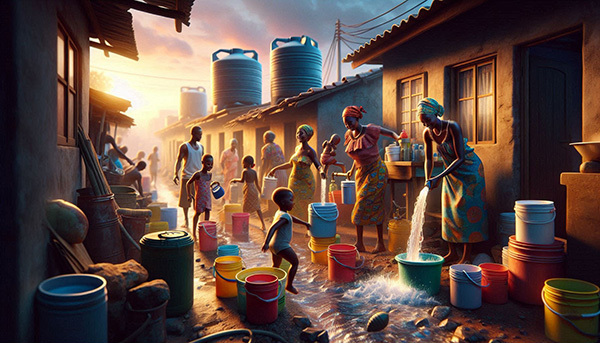
Real-Life Strategy: Ghanaians have developed reflexes for water. You can be deep asleep, but the sound of gurgling pipes at 3 a.m. will wake you like a fire alarm. Suddenly the whole house is up — moms, kids, even the cat — filling buckets like it’s the last scene in an action movie.
Every Ghanaian home has a water stash that looks like a mini-apocalypse bunker:
- Buckets in the bathroom
- Gallons under the bed
- Jerry cans behind the fridge
- And huge black polytanks on rooftops, like water guardians watching the city from above
Pro Tip: If you visit someone in Ghana and you don’t see at least 3 water containers in their hallway, they’re either new to the country… or in deep denial.
Fun Fact:
- Ghanaians brush their teeth with bottled water,
- Bathe with stored water,
- Wash dishes with collected rainwater,
- But somehow, the plants get fresh hose water like they’re royalty.
Don’t ask. It’s just… plant privilege.
And yet, the moment the water does show up during the day? You hear it. Someone will scream from the back: “Water is coming oooo!” That announcement is more powerful than any presidential speech.
Kids stop playing. Aunties drop their cooking. Everyone becomes a water engineer for the next 90 minutes.
True Story: One guy installed a tap sensor that sends a text message to his phone when water starts to flow. When I asked him why, he said: “Because I’ve been betrayed before.”
In Ghana, we don’t fetch water. We chase it. We celebrate it. We pray for it. Because when the tap runs clear, even if just for 12 minutes, you suddenly believe in second chances, in small miracles, in love.
And let’s not forget: Sometimes, you fetch water today… Only to discover tomorrow it was actually from a pipe with a goat nap in it. But hey — just boil it, add lime, and keep the faith.
Because in Ghana, water isn’t just a resource. It’s a test. It’s a hustle. It’s an Olympic sport with buckets.
And if you win? You sleep like a champion — one leg on the bed, one hand on your jerry can, smiling at the sound of silence… because the tank is full.
Boreholes: The Real MVP
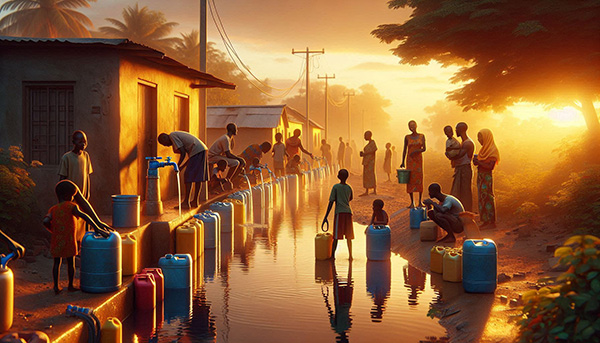
When pipes fail and tanks run dry, Ghanaians turn to the unsung hero of the community: the borehole.
A borehole is like that reliable aunty — doesn’t say much, doesn’t dress fancy, but shows up every single time when others disappear.
In many neighborhoods, the borehole is life itself. It’s the modern village well — the source of hydration, hygiene, and humble bragging rights. You can always spot a borehole household by one thing: their skin is glowing, their clothes are clean, and they walk with confidence. That’s the power of constant water.
But not all boreholes are created equal:
- Some are free, and guarded like national treasure.
- Others have a “per-bucket pricing system” that’ll make you feel like you’re buying shares in a water company.
- A few even have VIP access hours — like a nightclub, but with jerry cans.
Fun Fact: One landlord in Spintex reportedly installed a borehole and added ₵200 to rent. His reason? “This water is spiritual.”
And spiritual, it may be — because once you taste borehole water, you’ll realize it’s colder, fresher, and somehow always hits differently than city water.
True Life Hack: A neighborhood with two boreholes becomes a borehole economy. You’ll see lines forming at 4 a.m., people with carts, bikes, babies strapped on backs, and Bluetooth speakers blaring Shatta Wale — all just to fetch that sweet, underground blessing.
Some even do borehole brunch dates: “Let’s fetch together… then eat waakye.”
In Ghana, a borehole isn’t just a water source. It’s a status symbol, a community builder, and the only place where people don’t mind waiting 45 minutes — unless someone jumps the line. Then it’s war.
The Daily Hustle: Surviving Ghana’s Utility Olympics
In Ghana, your life revolves around a simple formula: Electricity × Water ÷ Hope = Survival
Everything — and I mean everything — is planned around these two elusive friends: Power and Water.
- Cooking? Only when there’s light.
- Laundry? Only when there’s water.
- Zoom meetings? May the ECG gods smile upon you.
One woman told me: “I do my laundry like I’m in a Netflix heist movie. Watch the weather. Time the light. Plan the escape. Execute the mission.”
And don’t even try to relax — because just when you sit down with your jollof and chilled malt, you’ll hear the dreaded buzz: Power off.
In response, people spring into action:
- Rush to plug in power banks.
- Fill kettles and bathtubs.
- Charge every rechargeable device — even ones they don’t use.
Fun Fact: Ghanaians own more power banks than smartphones. One guy even named his: “This is Veronica. She’s saved me more than ECG.”
And when both power and water are missing? You take a deep breath, go outside, sit on a plastic chair, and start philosophizing: “What is life? Is this how God intended it?”
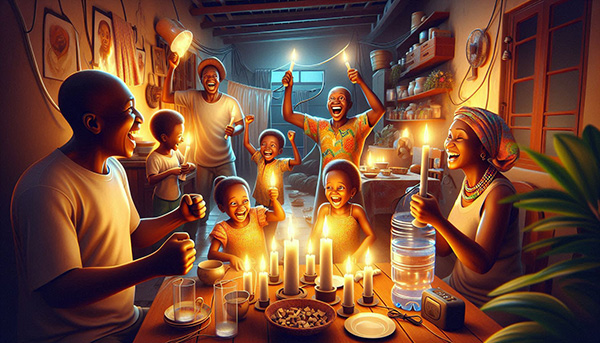
But when both power and water miraculously return at the same time? 🎉 You celebrate like it’s Independence Day. Neighbors shout across walls. Kids dance. Adults become temporary electricians, checking sockets and switches like NASA engineers during liftoff.
Because that moment — when the fan is spinning, the shower is running, and your rice cooker is blinking with purpose — that moment is pure joy.
Ghanaians don’t just live. They survive creatively, laugh intentionally, and celebrate electricity like it’s a birthday party.
And that, my friends, is the Ghanaian daily hustle — full of prayers, jerry cans, and jokes stronger than your Wi-Fi.
Perspective Shift: Resilience, Kelewele, and Candles
Yet somehow… people smile.
Yes — even in the middle of a blackout, when the fridge is now a sauna and the tap sounds like it owes you money — Ghanaians smile.
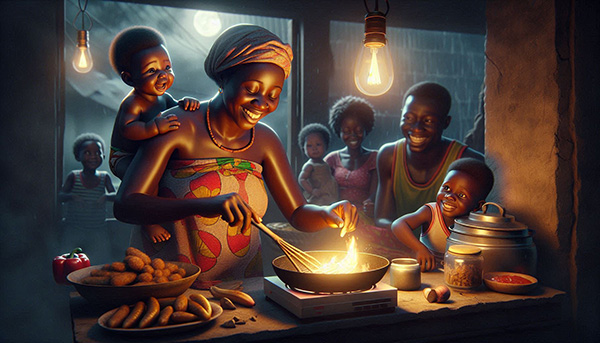
They don’t just survive — they joke, dance, hustle, and fry plantains under candlelight like it’s Coachella.
You haven’t truly experienced resilience until you’ve seen this: A mother frying kelewele by candlelight, pumping water with one hand, holding a baby on her back, and answering a WhatsApp voice note about school fees — all before 7 a.m.
Fun Fact: In Ghana, “light off” isn’t the end of the day — it’s the beginning of storytelling. Some folks say, “When ECG goes off, the real conversation begins.”
Kids do homework by flashlight. Couples go on spontaneous dates to charge phones at restaurants. The community becomes a support group powered by humor and extension cords.
Why It Matters: Hope in Buckets and Bulbs
This isn’t just about broken pipes and flickering bulbs. It’s deeper. It’s about how Ghanaians turn chaos into culture, and struggle into art.
A working bulb in the hallway? A flowing tap in the kitchen? That’s not just infrastructure. That’s hope, packaged in volts and liters.
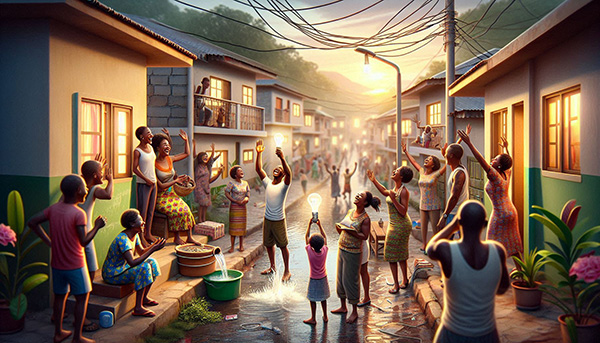
When light returns, there’s a collective “Yessssss!” Neighbors shout. TV volumes go up. Group chats explode: “Light is back ooo!” “Quick, boil water!” “Charge EVERYTHING!”
Fun Fact: Ghanaians don’t say “power outage.” They say “they’ve taken the light” — like ECG personally came into their house and stole it with their own two hands.
So the next time your coffee machine breaks or your Wi-Fi slows down, take a breath. Remember: Somewhere in Accra, someone is charging their laptop at a neighbor’s house,
Author: John S. Morlu II, CPA is the CEO and Chief Strategist of JS Morlu, leads a licensed public accounting and management consultancy firm. He has more than 20 years of professional experience in auditing and advisory work, including service as Auditor General of Liberia and FAR and DCAA compliance work at Unisys Federal Systems. The firm’s technology products include AI-powered reconciliation software (ReckSoft.com) and advanced cloud accounting solutions (FinovatePro.com), built for finance and operations teams.