
By: John S. Morlu II, CPA
Introduction: The Perils of the Price Trap
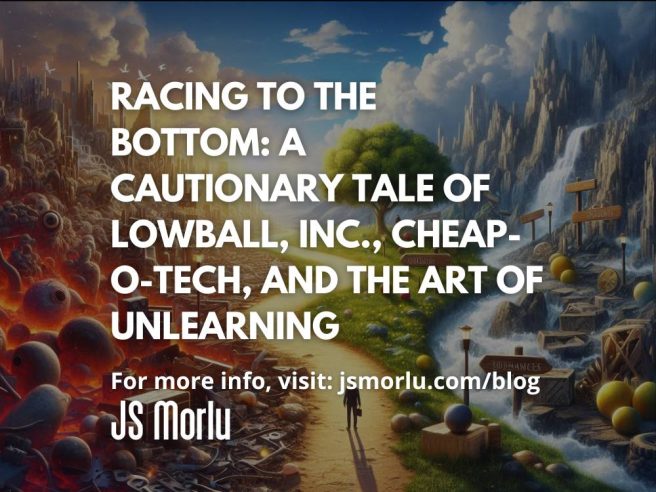
Imagine a world where every business is locked in a relentless pursuit to be the cheapest, slashing prices and squeezing margins, a fierce race to the bottom where the prize for “winning” is bankruptcy. Welcome to the unforgiving battlefield of commoditization, where countless companies—driven by the illusion that lower prices alone will lead to success—end up self-destructing. The harsh truth? When you compete solely on price, you risk losing not only profits but the very identity of your business.
In this tale of strategy gone wrong, we meet three fictional companies: Lowball, Inc., Cheap-o-Tech, and Luxitude. Each set out with a bold vision but faced wildly different fates. From the cut-rate chaos of Lowball, Inc. to the glitchy gadgets of Cheap-o-Tech, and finally, the surprising success of Luxitude, these businesses reveal the reality of price wars, the allure of differentiation, and the true value of quality.
Here, you’ll uncover why price isn’t everything—and why racing to the bottom might leave your business in last place. Each chapter blends humor with hard truths, exploring the choices that led these companies to either doom or triumph. By the end, you’ll know not only how to avoid the price trap but how to build a brand so valuable that people will willingly pay a premium for it. So, turn the page, and get ready to learn from the missteps, mishaps, and victories of those who dared to aim higher in a world obsessed with low prices.

Chapter 1: The Rise of Lowball, Inc.
In the heart of Plainsville, Tim was seen as a revolutionary—or at least, he thought so. His mission was simple: create a company that could sell anything cheaper than anyone else. This wasn’t just a tagline; it was the core philosophy of Lowball, Inc. If there was a way to cut costs, Tim would find it. Quality took a backseat, customer experience was an afterthought, and in Tim’s eyes, these were simply obstacles in his race to offer the lowest prices.
Lowball, Inc. quickly became the go-to place for frugal customers. Tim felt like a genius, watching sales shoot up as customers flocked to his store. His logic seemed bulletproof: lower prices equal more sales, right? However, there was one detail he overlooked—the impact of low prices on his business’s reputation and long-term survival.
Tim’s customers, many of whom came for a quick bargain, soon realized they were getting precisely what they paid for. Shoes fell apart within weeks, electronics fizzled out after a few uses, and household items failed to deliver on even basic promises. The customer complaints started slowly, a few here and there, but then grew into a deluge. Social media posts began circulating with hashtags like #LowballLetdown and #YouGetWhatYouPayFor.
Yet, Tim clung to his strategy. “Maybe they don’t get it,” he thought, convinced his critics just didn’t understand the brilliance of the bargain. However, the numbers didn’t lie: customers were defecting, sales were dropping, and Lowball, Inc.’s profits were slipping. Tim had joined the dreaded Race to the Bottom—the deadliest business competition, where the “winner” ends up with an unsustainable, often failing business.

Chapter 2: The Arrival of Cheap-o-Tech
Across town, a tech entrepreneur named Sarah decided to take inspiration from Tim’s approach to affordability. Her venture, Cheap-o-Tech, aimed to bring high-tech gadgets to the masses at the lowest possible prices. The tagline? “Cutting-edge tech, budget prices.” And, on paper, it was brilliant. She reasoned that people loved technology but hated paying top dollar for it.
The flagship product, The GlitchMaster 2000, was advertised as the “smartphone of the future”—for half the cost of a leading iPhone or Samsung model. Initial sales were strong, with bargain-hunters eager to save money while jumping into the world of tech. But Sarah had skipped over a critical detail: The GlitchMaster 2000 was aptly named. Users reported screens that froze frequently, camera functions that “glitched” into psychedelic colors, and batteries that died faster than they could charge. The device’s “features” became the laughingstock of the tech forums.
Sarah was caught in the price trap. To keep prices low, she was forced to compromise on everything from components to customer support. Soon, “Cheap-o-Tech” became synonymous with “cheap junk” in the minds of her customers. Social media influencers began roasting her products, memes proliferated, and sales began to plummet. Cheap-o-Tech was now running on fumes, losing the trust of customers and being outclassed by even mid-tier brands.
Realizing her predicament, Sarah faced a difficult choice: continue racing to the bottom and keep slashing costs or pivot and try to create real value. It was time to confront an uncomfortable truth—you can’t build loyalty on rock-bottom prices alone.

Chapter 3: Learning from Winners, a.k.a., The Anti-Price Warriors
Across the same business landscape, another company, Luxitude, took a drastically different approach. Unlike Lowball, Inc. and Cheap-o-Tech, Luxitude wasn’t aiming for the mass market. Instead, they positioned themselves as a high-end brand, offering handcrafted, artisanal products. They sold “Lifestyle Enhancers”—simple items like coasters, teapots, and journals, but with a luxurious twist. Each item came with an experience, a story, and an aura of prestige.
For Luxitude, price was part of the brand’s identity. Their customers saw the high prices not as a disadvantage but as an indication of quality, exclusivity, and craftsmanship. Luxitude’s CEO, Luna Luxe, was a marketing mastermind who understood that people buy with emotion, not logic. “Anyone can sell a coaster,” she’d say with a knowing smile, “but only Luxitude sells the feeling of prestige and elegance.” She famously coined the term “Affordable Indulgence,” convincing customers that they deserved to splurge on something that made them feel special.
While Tim and Sarah fought over price, Luna didn’t give it a second thought. Instead, she focused on creating a brand that people wanted to be associated with. Her strategy worked wonders. Luxitude’s coasters, priced at a staggering $75 each, weren’t just coasters; they were symbols of taste and sophistication. And the best part? Because her brand was built on quality and exclusivity, Luxitude didn’t have to worry about competitors slashing prices—they simply weren’t in the same league.

Chapter 4: The Twist—A Failed Rebrand for Lowball, Inc.
Desperate to save his business, Tim decided to pivot. Inspired by Luxitude’s success, he decided to turn Lowball, Inc. into a “premium” brand. Gone were the generic signs and dollar-store vibe. In their place, Tim invested in a sleek new logo, polished product displays, and a website makeover. His new branding campaign, “Experience Elegance,” featured glossy ads and lofty promises. The only problem? Tim had forgotten to upgrade the actual products.
Customers weren’t fooled. They saw the same old flimsy products with a shiny new label and a higher price. The social media backlash was instant and brutal. Lowball, Inc. became a case study in failed rebranding—Tim’s price-focused business model was fundamentally incompatible with a premium image. And as his debt piled up, Tim realized the brutal truth: you can’t build a premium brand overnight.

Chapter 5: A Cheap-o-Tech Epiphany
Meanwhile, Sarah of Cheap-o-Tech also faced mounting troubles. After endless complaints about The GlitchMaster 2000, she had no choice but to admit her approach was flawed. “We’ve been selling budget tech for the sake of being cheap,” she admitted in a team meeting. “But what if we built something affordable that people actually love?”
Under this new philosophy, Sarah poured resources into R&D, bringing in talented engineers to create what became known as The SeamlessMaster 3000. The device still had an affordable price point, but it actually worked reliably. Customers were pleasantly surprised, and Cheap-o-Tech’s reputation started to rebound. “Turns out, people like budget tech that works,” Sarah quipped, reflecting on the obvious in hindsight.
Sarah had finally learned a crucial lesson: people are willing to pay for quality. Cheap-o-Tech didn’t need to be the cheapest, just the best value in its category.

Chapter 6: The Takeaway—Why Price Isn’t the Real Problem
The stories of Lowball, Inc., Cheap-o-Tech, and Luxitude reveal a powerful lesson for businesses: price isn’t everything. While it’s easy to believe that customers only care about cost, the truth is they’re often willing to pay more for something that feels valuable, special, and, yes, even luxurious.
Lowball, Inc. learned the hard way that slashing prices to stay competitive can turn a brand into a bargain bin name. Cheap-o-Tech realized that low prices only go so far without quality. And Luxitude demonstrated the immense value of standing apart, offering something unique, and building a brand that isn’t afraid to charge for quality.
Tim and Sarah’s experience highlights a deeper truth in business: The Race to the Bottom is a no-win game. When you compete solely on price, you undermine what makes your brand valuable and often attract customers who lack loyalty. Instead, differentiation, quality, and brand experience create a competitive edge that’s harder to replicate and less susceptible to being undercut by cheaper alternatives.
Today’s most successful brands—Apple, Tesla, and even seemingly simple luxury brands like Luxitude—succeed not because they offer the lowest prices but because they deliver value beyond the dollar amount. They’ve built loyal followings because people don’t just want a product; they want the identity, status, and satisfaction associated with that product.

Chapter 7: Epilogue-Rising Above the Race to the Bottom
Years after Lowball, Inc.’s collapse, Tim returned to Plainsville with a newfound mission and a fresh perspective. His new venture, ValueRise, wasn’t built on bargain prices but on the principles of quality and integrity. With every product he sold, Tim embodied his hard-won realization: “We don’t sell cheap anymore. We sell quality. And people are willing to pay for it.” The store became a beacon for customers who valued reliability over the short-lived thrill of a “deal.” ValueRise wasn’t chasing luxury like Luxitude, nor was it sinking to bargain-basement tactics. Instead, it carved out a respected position as a mid-range brand that combined fair prices with lasting value—something Tim had once overlooked but now championed wholeheartedly.
Tim’s story became legendary, a lesson etched into business school curricula as a cautionary tale of what can go wrong when you confuse low price with real value. Where Lowball had once raced to the bottom, ValueRise chose the higher road, standing for something beyond just affordability. Customers came to ValueRise not because it was the cheapest but because it offered them something more enduring—products they could trust, a brand they respected, and an experience that brought satisfaction beyond the price tag.
Reflecting on his journey, Tim understood that his greatest lesson wasn’t in finding the perfect price point—it was in building a brand that resonated with people. Through trials, missteps, and reinvention, he and his partner Sarah learned what many businesses miss: the true worth of a brand lies not in its price, but in the value it brings to people’s lives. In a crowded market where everyone races to be the cheapest, the real success lies with those who refuse to play by price alone, choosing instead to rise above by standing for something meaningful, enduring, and rare.
Author: John S. Morlu II, CPA is the CEO and Chief Strategist of JS Morlu, leads a licensed public accounting and management consultancy firm. He has more than 20 years of professional experience in auditing and advisory work, including service as Auditor General of Liberia and FAR and DCAA compliance work at Unisys Federal Systems. The firm’s technology products include AI-powered reconciliation software (ReckSoft.com), a handyman services platform (Fixaars.com) and advanced cloud accounting solutions (FinovatePro.com), built for finance and operations teams.