
By: John S. Morlu II, CPA
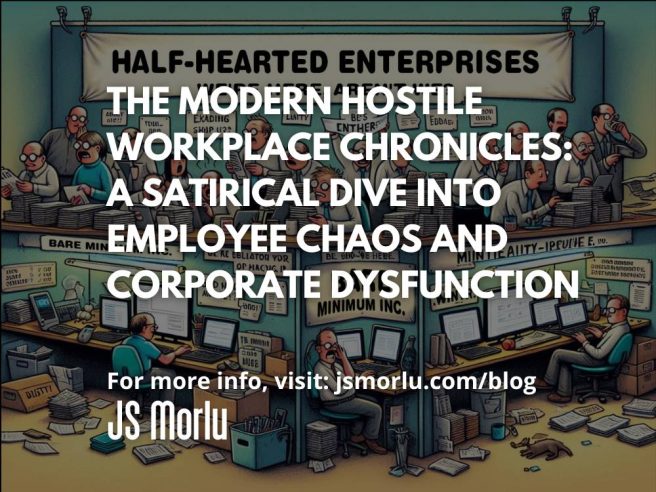
In the chaotic, soul-crushing metropolis of Worktown, two companies stood as monuments to the slow demise of professional standards: Half-Hearted Enterprises and Bare Minimum Inc. These rival firms were teetering on the brink of bankruptcy, not because of fierce competition, but because of their own employees’ relentless commitment to mediocrity. Of course, these companies are purely fictional—unless you happen to recognize them. Then again, maybe they’re all too familiar.
In these hallowed halls of dysfunction, laziness was lauded as efficiency, and those rare souls who sought to deliver quality work were treated like unwelcome prophets bearing bad news. Competence? That was for suckers. Diligence? A quaint idea that went out of fashion alongside dial-up internet. Quality work was as mythical as unicorns, whispered about but never seen. Supervisors, weary from years of fighting this uphill battle, had become glorified janitors, endlessly sweeping up the mess of careless emails, sloppy reports, and missed deadlines. Their hopes of fostering excellence were buried beneath mountains of unfinished projects, cryptic one-word responses, and a profound lack of accountability.
These companies didn’t just tolerate incompetence—they celebrated it. And in doing so, they revealed a deeper, more troubling truth: This wasn’t just a quirky tale of workplace antics; it was a reflection of the growing dysfunction in offices everywhere. It was the story of how negligence, half-hearted effort, and apathy had become the corporate norms that were bleeding businesses dry.
So sit back, grab your cup of coffee (you’ll need it), and let’s dive into this wild ride through the absurdity of modern workplaces. After all, behind every satirical punchline, there’s an unsettling reality lurking—one that might just make you want to fix your own office before it, too, spirals into chaos.

Chapter 1: Enter Half-Hearted Enterprises
Welcome to Half-Hearted Enterprises, where ambition comes to die and “barely trying” is practically an Olympic sport. Led by the illustrious CEO Lazy McShrug, this company had perfected the art of mediocrity. Their company motto? “We’re Here, Aren’t We?” It hung proudly in the break room next to a dusty vending machine and a fridge full of unclaimed sandwiches that were, frankly, more organized than their entire accounting department.
Meet the Team
The star players at Half-Hearted Enterprises included Betty the Bumbler and Sam the Slack Specialist. Betty’s talent? She had a magical ability to hit “Reply All” on every email, even those involving HR matters. The office lore says she once “replied all” to a 300-person thread with a picture of her cat—named Captain Chaos, fittingly—because, and I quote, “Everyone deserves to see his cuteness.” Half of the company agreed, while the other half plotted their resignation over lunch.
Then there was Sam, who had reached legendary status not because of his work ethic but because of his breathtaking ability to not care. Sam could send an email so devoid of meaning that you’d wonder if it was written by an AI programmed to troll humans. His favorite response was “Noted, thanks”—a phrase that did nothing and went nowhere. Legend has it, one time Sam was asked to produce a report on a key client, and he handed in a single page titled “Some Stuff.” The contents? Four bullet points about how it “might rain tomorrow” and “the coffee machine is broken.” Pure genius. The client never received the report, but they did appreciate the heads-up about the weather.
Fun Fact
Did you know that a goldfish has a memory span of about 5 seconds? That’s actually five seconds longer than most employees at Half-Hearted Enterprises can focus in a meeting.
Management Madness
The supervisors at Half-Hearted Enterprises were the true unsung martyrs. Take Desmond Despair, who lived up to his name by developing a stress-induced twitch after trying to explain the concept of “punctuation” to his team for the 17th time. Once, after receiving yet another email that read “Got it, will do!” with zero follow-up action, Desmond was caught whispering to the office plant: “At least you grow when watered.” The plant seemed more responsive than Betty.
The head of HR, Miriam Mayday, frequently lamented that her job felt more like daycare than human resources. She had once walked into the break room to find two employees in a heated debate over the proper way to microwave fish (spoiler: there isn’t one). Miriam muttered, “Is this my life now?” before resigning herself to adding another line in the employee handbook about seafood etiquette.

Chapter 2: Bare Minimum Inc.: Home of “Good Enough”
Across the street was Half-Hearted Enterprises’ natural rival: Bare Minimum Inc. If Half-Hearted Enterprises was about barely trying, Bare Minimum Inc. was about doing just enough to ensure they still had jobs. Led by the visionary CEO Barely T. Doing, the company prided itself on a philosophy that could be summed up in one glorious word: “Eh.”
The Employees Who Make it Work (Barely)
At the heart of Bare Minimum Inc. was Janet “Just-Get-It-Done” Jackson, who was allergic to overachieving. Her crowning achievement came when she was tasked with redesigning the company website. Her masterpiece? A homepage with nothing but the word “Website” in Times New Roman, font size 12, in the middle of a plain white background. When her manager asked her, “Janet, where’s the content?” she coolly responded, “People know what a website is. Why explain it?” You couldn’t argue with that logic, though her manager certainly tried (and failed).
Then there was Dan the Distracted. Dan’s job was to process invoices, but his true passion lay in scrolling through social media, particularly Instagram pages dedicated to dogs in Halloween costumes. When a batch of invoices mysteriously disappeared, Dan was asked if he had seen them. He replied, “I’m 90% sure I saw them… somewhere around here, probably?” They were never found, but Dan did send the entire office an urgent email with the subject line: “IMPORTANT: LOOK AT THIS DOG DRESSED AS A TACO.” So, there’s that.
Fun Fact
Speaking of tacos, did you know that the largest taco ever made weighed over 2 tons? That’s approximately the weight of all the uncompleted work at Bare Minimum Inc. on any given day.

Chapter 3: Supervisors: The Unsung Martyrs
Supervisors at both Half-Hearted Enterprises and Bare Minimum Inc. were, frankly, heroic. They were the unsung martyrs in a war against chaos and incompetence, fighting battles like the legendary Email Wars—where every “Noted, thanks” was a dagger to their sanity.
Margaret Martyr, a supervisor at Bare Minimum, had given up hope that anyone would do their jobs without being spoon-fed every instruction. She once received an email that simply read: “Got it.” The problem? No one knew what “it” was, and the task, whatever it had been, was most definitely not “gotten.” When she asked for clarification, the employee responded with: “Got what? What are you talking about?”
Her counterpart, Paul Patience at Half-Hearted, wasn’t faring much better. After receiving a 10-page report that was riddled with typos—Paul suspected it had been written by a chimpanzee with access to a keyboard—he confronted Emily Errors, the author. “Emily, what happened?” he asked, holding up the monstrosity. Emily shrugged and replied, “Spellcheck didn’t catch anything, so I figured it was good!” Spellcheck had clearly given up halfway through, much like everyone else at Half-Hearted.
Fun Fact
Spellcheck, though helpful, cannot fix broken souls or replace the ability to care—two things sorely missing at both companies.

Chapter 4: The Board of Directors: Blind Leading the Blind
Now, let’s talk leadership. Every great company has visionary leaders… but not these two. At Bare Minimum Inc., CEO Barely T. Doing had mastered the art of pushing problems into the abyss of “We’ll figure that out later.” Later, it turned out, never came. In one infamous instance, Bare Minimum lost their biggest client because no one had responded to a single email in six months. When asked about the issue, Barely shrugged and said, “Well, we are the Bare Minimum. They should’ve expected it.”
Over at Half-Hearted Enterprises, CEO Lazy McShrug had an equally stunning track record. When his board asked him why employee productivity had plummeted to near-zero, Lazy blinked slowly and said, “Look, they show up. What more do you want? Effort?” His philosophy was simple: If it wasn’t literally on fire, it was fine. And even if it was on fire, well, fire extinguishers were optional.
Fun Fact
Procrastination is scientifically proven to give you temporary happiness. But remember, so does eating cake for breakfast… and neither is a good long-term strategy for success. Just ask the CEOs of these fine establishments.

Chapter 5: The Grand Finale: Corporate Carnage
In the end, both Half-Hearted Enterprises and Bare Minimum Inc. followed the same tragic yet hilarious trajectory—straight into the abyss of corporate oblivion. Like a pair of sinking ships with captains who insisted, “It’s fine, we’ve got floaties,” they drifted into the ocean of irrelevance, blissfully unaware of the sharks circling below. Their steadfast reputation for doing the absolute least had finally caught up with them, and down they went—not in a blaze of glory, but in a slow, smoldering mess, like a forgotten Pop-Tart wedged in the back of the toaster. It was the kind of fire where people just stared blankly, hoping someone else would get up and deal with it. Spoiler: No one ever did.
At Half-Hearted Enterprises, the employees continued perfecting the art of “looking busy.” It became a form of performance art. In fact, if you walked into the office at any given moment, you might think you had entered a mime convention. People walked briskly with purpose—but where? No one knew. Papers were shuffled, emails were sent, but it was all for show. After all, “being seen working” was much more important than “actually working.”
Meanwhile, Bare Minimum Inc. wasn’t faring much better. In fact, they were setting new world records for corporate inertia. Their employees had developed an almost Olympic-level skill for dodging responsibility. Dan the Distracted once spent an entire week working on a PowerPoint slide—one slide—while Janet “Just-Get-It-Done” Jackson mastered the art of starting a task only to immediately forget about it. When confronted with a deadline, her response was always a casual “Eh, it’ll get done… eventually.”
Supervisors, meanwhile, were on the verge of losing their sanity completely. Their lives had become an endless game of Whac-A-Mole, except the moles were spelling errors, missed deadlines, and nonsensical email chains. Desmond Despair, after his seventh hour of reformatting a report that had been written entirely in Comic Sans, could be heard muttering to himself: “This is fine… everything is fine.” And then he threw his stapler out the window.
One fateful day, Barely T. Doing, the fearless (or clueless) CEO of Bare Minimum Inc., was asked why the company hadn’t responded to a major client in over six months. Barely blinked slowly, thought for a moment, and replied, “Well, if they really needed something, they would have called. We’re not in the business of chasing people. We’re the ‘low-key’ company.” And that, ladies and gentlemen, was how Bare Minimum lost its biggest client and still managed to act surprised.
At Half-Hearted Enterprises, Lazy McShrug was confronted by his board of directors about the company’s plummeting productivity. His response? A deep sigh and an even deeper shrug. “Look, as long as people are here physically, that’s half the battle. We’re called Half-Hearted for a reason, people!” It was a moment of brilliance in its own right—embracing failure as a business model. The board, equally as indifferent, nodded in agreement. And thus, the downward spiral continued.

The Moral of the Story
Never underestimate the power of a half-assed job. It takes years, even decades, to build a company from the ground up, but only a few “Noted, thanks” emails, coupled with a nonchalant shrug, to bring it all crashing down. Half-Hearted Enterprises and Bare Minimum Inc. serve as shining examples of what happens when apathy meets incompetence—it’s a marriage made in corporate hell. Remember: incompetence may not build empires, but it sure does make for legendary office gossip and plenty of “I told you so” moments.
Fun Fact
Mediocrity is like a mullet—it never really goes out of style, but it was never really in style either. Like the infamous hairstyle, it hangs around in the background, unremarkable yet oddly persistent. And just when you think you’ve moved past it, there it is again, showing up to the company picnic in all its glory.
Corporate Carnage By the Numbers
- Number of times a task was completed correctly the first time: 0
- Number of emails that contained the phrase “Noted, thanks” without any actual follow-up: 3,457
- Average length of time spent “researching” (a.k.a. browsing Instagram): 4.8 hours per work day
- Number of PowerPoint presentations finished on time: 1 (and even that was debatable)
- Number of employees who truly cared: Approximately 0.5 (we’re giving Dan the benefit of the doubt on this one)
By the time the dust settled, both companies had imploded, their remaining employees scattering to new jobs where, one can only hope, they were forced to actually work for once. Supervisors were left with permanent eye twitches and a deep mistrust of any email that didn’t come with a detailed follow-up. The CEOs? Well, they’re likely spending their days writing self-help books titled “How to Succeed in Business Without Really Trying”—or at least, they’re planning to… eventually.
And so, dear reader, we leave you with this: If you ever find yourself in a workplace where “just good enough” is the gold standard, run. Run fast. Because in the corporate jungle, survival doesn’t come from being the fastest or the smartest—it comes from avoiding the office plant conversations and knowing when to hit “reply all” with the perfect amount of passive-aggressive professionalism.
Until then, keep your “Noted, thanks” responses short and your sanity intact.
Author: John S. Morlu II, CPA is the CEO and Chief Strategist of JS Morlu, leads a licensed public accounting and management consultancy firm. He has more than 20 years of professional experience in auditing and advisory work, including service as Auditor General of Liberia and FAR and DCAA compliance work at Unisys Federal Systems. The firm’s technology products include AI-powered reconciliation software (ReckSoft.com) and advanced cloud accounting solutions (FinovatePro.com), built for finance and operations teams.